
World Cup 2026: How to Use an AI Partner as a Virtual Employee
World Cup 2026 is not just a sports event; it is an information-coordination problem. Here is how an AI Partner can act as a cited, permissioned virtual employee for schedules, research, sentiment, travel context, and matchday workflows.
The best way to use AI during World Cup 2026 is not to ask a chatbot, “Who will win tonight?” The better move is to delegate a living information job: track the schedule, check sources, remember preferences, summarize noise, and hand you a cited matchday brief before you need it.
That is why the right mental model is an AI Partner / virtual employee — the English source should describe the Chinese localized term without embedding non-English characters. A virtual employee is not a magic predictor. It is a permissioned workspace assistant for source gathering, schedule interpretation, travel context, reminders, chat synthesis, sentiment tracking, and recaps.
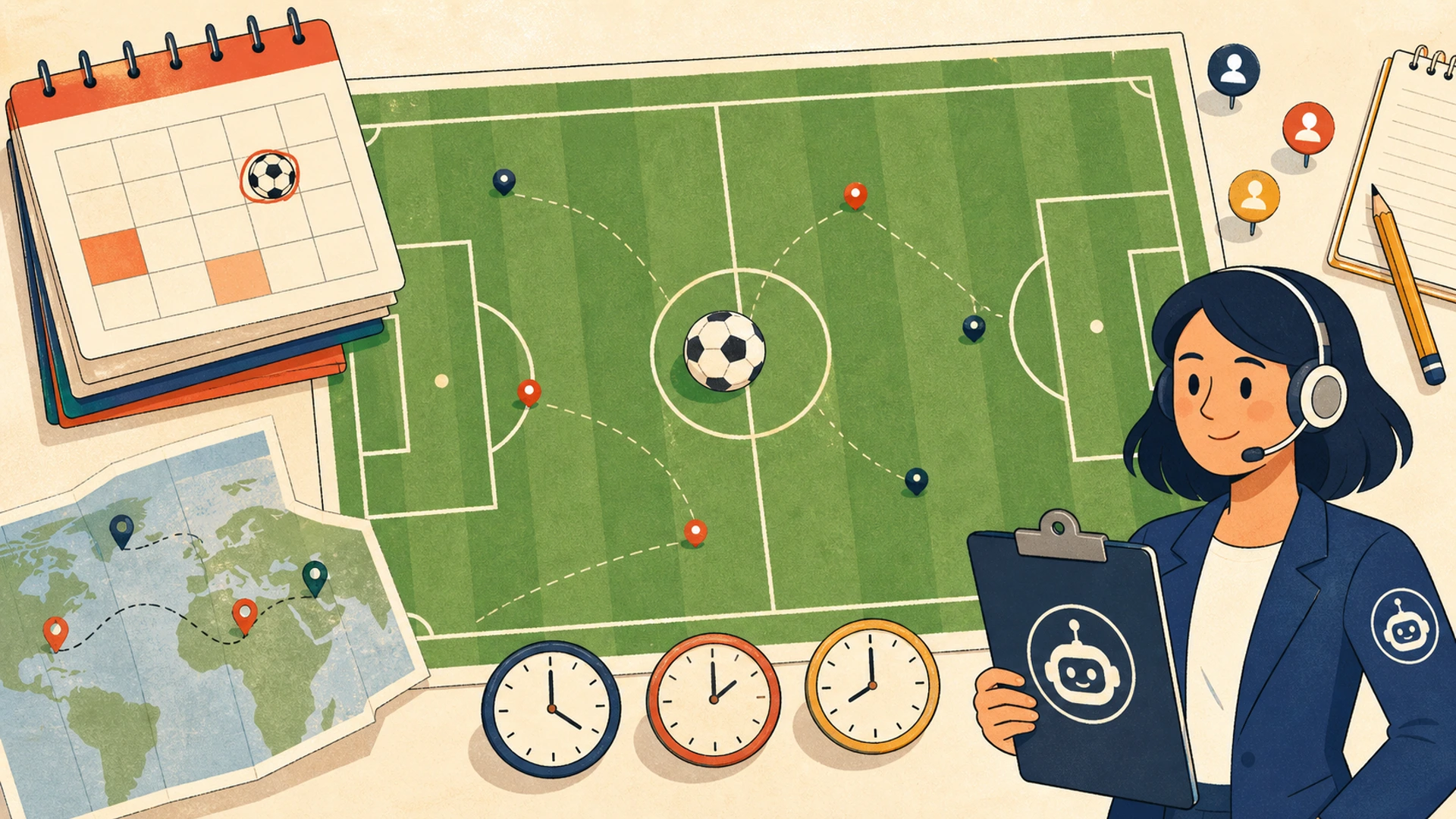 Flat editorial illustration of a generic football pitch, calendar cards, time-zone clocks, map pins, and a friendly AI virtual employee holding a clipboard
The tournament is an information-coordination problem
World Cup 2026 runs from June 11 to July 19, 2026, and is hosted across the United States, Canada, and Mexico.1 The expanded format includes 48 teams, 12 groups of four teams, 72 group-stage matches, and a Round of 32 in which the top two teams from each group plus the eight best third-place teams advance.2 Across the full tournament, PBS/AP reports 104 matches, 16 host cities or stadiums, 1,248 players, and 39 days of competition.3
The geography matters as much as the football. The host-city footprint spans 11 U.S. cities, three cities in Mexico, and two cities in Canada.14 PBS/AP reports that the U.S. will host 78 matches, while Mexico and Canada will host 13 matches each.3 FIFA also lists a mobile ticketing app and a companion app.5 Meanwhile, North American time zones are a planning issue for fans watching or traveling across regions.6
This is why “latest information” is not a single search result. It is a stream of official schedules, app updates, travel constraints, fan conversations, time conversions, media reports, team news, calendars, and group-chat logistics. FIFA and Lenovo have referenced seven million projected attendees and six billion projected home viewers.7
A chatbot answers when asked. A virtual employee maintains context so you do not rebuild it every matchday.
What an AI Partner can actually do
IBM describes AI agents as systems that can reason, plan, use tools, and act toward goals.8 For sports, the useful job is rarely “write me a paragraph about a team.” It is closer to:
- “Keep a watchlist of the teams I follow.”
- “Convert the matches I care about into my time zone.”
- “Summarize official schedule changes and cite the source.”
- “Give me a pre-match briefing that separates confirmed facts from commentary.”
- “Summarize my authorized group chat without leaking private context.”
Sports fans are already moving in this direction. IBM surveyed 20,864 fans and reported that 85% value AI in sports experiences, while 63% trust AI-generated sports content.9 Capgemini surveyed more than 12,000 fans and reported that 54% had shifted from Google or traditional search to AI tools for sports information, while 59% trusted AI-generated sports content.10 Treat those figures as demand for cited workflows, not permission to hallucinate.
The AI Partner’s job is to combine capabilities that used to be scattered across apps:
| Use case | Generic chatbot behavior | AI Partner / virtual employee behavior |
|---|---|---|
| Schedule lookup | Answers in chat | Maintains a source-linked schedule, converts times, and flags uncertainty |
| Deep research | Produces a broad summary | Separates official facts, reporting, and opinion; records sources |
| Match analysis | Generates a narrative | Builds a brief with context, caveats, and “what changed” |
| Memory | Forgets preferences unless restated | Remembers teams, time zones, travel plans, and recap style locally where possible |
| Sentiment | Says “fans are excited” | Summarizes scoped narratives and labels sentiment, not fact |
| Group coordination | Drafts a message | Produces a digest, proposes reminders, and waits for permission |
That last distinction is essential. Speed without source discipline creates a rumor machine. A good virtual employee should be fast enough to help and cautious enough to trust.
A practical matchday workflow
Here is a workflow worth delegating. It treats the AI Partner as a coordinator, not an oracle.
 Flat workflow illustration showing source-cited retrieval, matchday briefing, reminders, post-match recap, and group-chat digest
Pre-match briefing. The worker session checks schedule sources, reputable news, and the user’s calendar. It produces kickoff time in the user’s time zone, venue, confirmed context, open questions, and links.
Reminder and logistics. The virtual employee proposes reminders and travel notes. It should not claim ticket inventory, hotel prices, visa timelines, transport guarantees, or stadium entry rules without a current cited source. High-impact decisions pause for human review.
Fact check during the news cycle. The worker session can monitor a watchlist and label items as official, reported, commentary, or unverified. It should never turn a popular social post into a fact.
Post-match recap. After the match, the worker writes a recap from authorized sources. If live data is not available, it says so. The recap can include “what changed,” “what to watch next,” and “links to verify.”
Group-chat digest. If the user authorizes an IM bridge, the AI Partner can summarize a Feishu, Slack, Telegram, Discord, WeCom, QQ, or WeChat beta conversation. It should only read connected channels. It can draft a digest or reminder, but sending should remain permissioned.
A reusable prompt for this workflow can be simple:
Create a matchday brief for [team/match]. Use only cited sources. Convert times to [my time zone]. Separate official facts, reported news, and opinion. Do not invent scores, injuries, lineups, odds, ticket availability, prices, or travel rules. End with a human-review checklist.
What MCPlato changes
MCPlato should not be positioned as another chatbot for sports trivia. The better framing is a workspace-level AI Partner: a virtual employee that coordinates worker sessions, preserves context, and leaves a reviewable artifact.
Sprite as orchestrator. In MCPlato, Sprite is the workspace-level coordinator. For a World Cup workspace, Sprite can break “help me follow the tournament” into worker sessions: schedule research, team research, travel watchlist, group digest, and sentiment summary.
Worker sessions for specialization. One worker can own schedule and time-zone research. Another can track a team watchlist. Another can summarize authorized group chats. Another can prepare recaps. Separation reduces context confusion.
Skills and Distill Skills. A matchday briefing, travel watchlist, or post-match recap should not be reinvented every time. MCPlato Skills package reusable instructions. Distill Skill turns a workflow that worked well into a repeatable pattern.
Wands and Artifacts. A Wand is a stateful workflow with phases, gates, and isolated resources. An Artifact is the durable output: a schedule board, briefing packet, travel watchlist, or fan narrative report.
Local-first context. Personal preferences, travel plans, and group-chat summaries are sensitive. MCPlato’s local-first posture helps when a World Cup workspace contains private calendars, family plans, budgets, or friend-group messages.
Permission framework. A virtual employee should ask before reading files, calling tools, or sending messages. Reading a public schedule is low-risk; reading private chat history or sending a message is not.
IM bridge delegation. Feishu, Slack, Telegram, Discord, WeCom, QQ, and WeChat beta can be delegation entry points when configured. The right claim is not “MCPlato can access any channel.” The right claim is “MCPlato can work through authorized channels you connect.”
Model routing and cost discipline. Extracting a kickoff time should not use the same capability as synthesizing a multi-source narrative. MCPlato can route lightweight work to cheaper paths while deeper analysis uses stronger reasoning.
Sentiment and memory: useful, but easy to misuse
Fan sentiment is attractive because World Cup conversations are emotional, multilingual, and fast-moving. It is also easy to overclaim.
Researchers have shown that large-scale football sentiment can be studied quantitatively: one football fan sentiment study analyzed 62,384,329 Reddit posts, 41 club subreddits, and 20,764 matches.11 That does not mean a personal AI Partner should pretend to know what “the fans” think from a few posts. It should state its scope: “from these authorized messages,” “from these cited articles,” or “from this public dataset.”
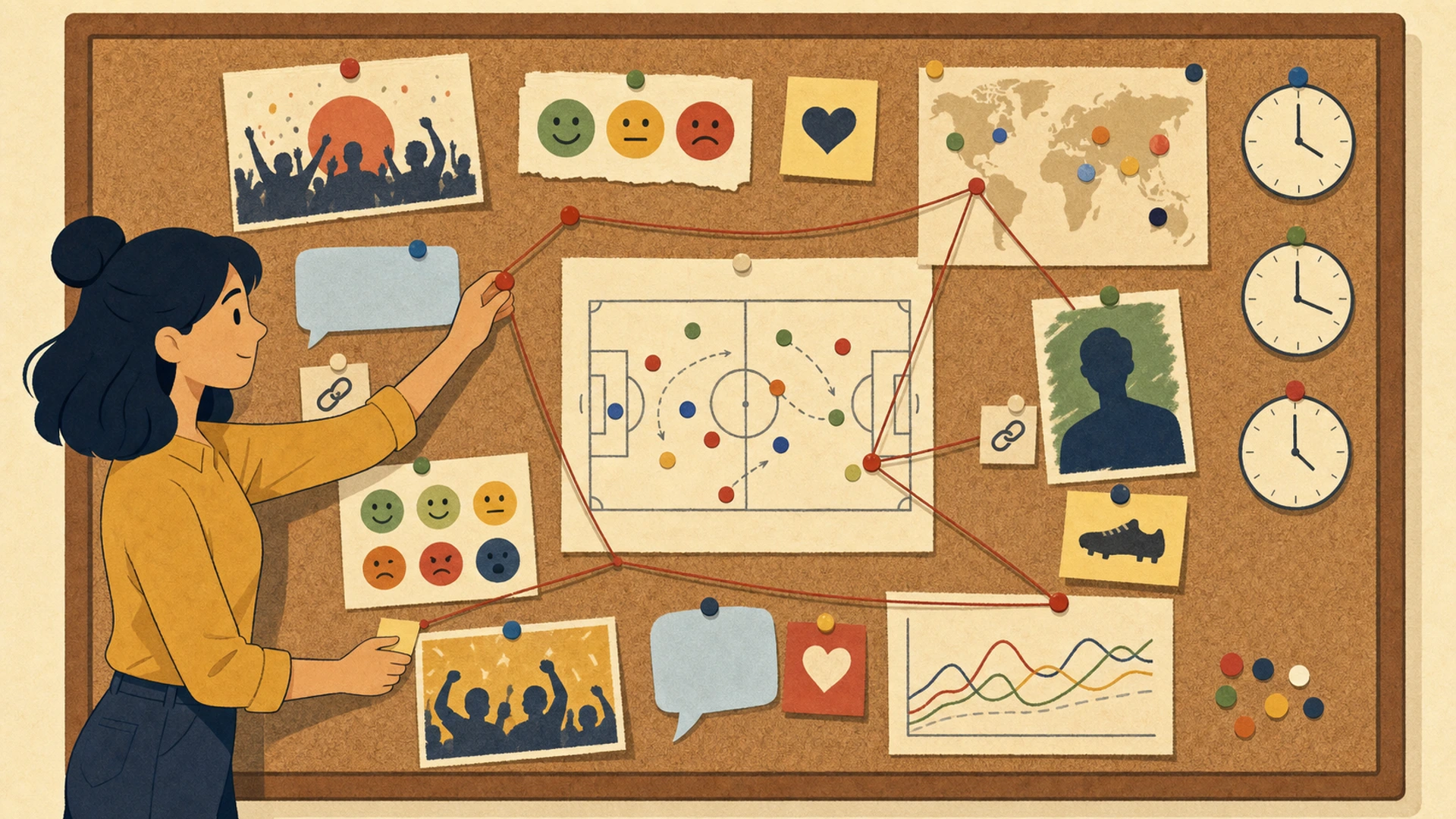 Hand-drawn board illustration with chat bubbles, emotion gauges, favorite-team pins, time-zone notes, and citation markers
Memory has the same tradeoff. It is useful when the AI Partner remembers that you follow a team, avoid spoilers, prefer short recaps, watch from a particular time zone, or coordinate with a family group. But memory becomes a risk when untrusted content can poison what the agent remembers. Unit 42 has documented indirect prompt injection attacks that target AI long-term memory.12 The rule is simple: remember preferences, not unverified claims; let humans review memory changes that affect future behavior.
Guardrails for a trustworthy World Cup workspace
A sports AI workflow should be designed around constraints.
Citations first. MIT Sloan’s guidance on hallucinations emphasizes grounding output in reliable sources and checking claims rather than treating fluency as truth.13 Every schedule fact, live update, travel claim, injury claim, lineup claim, odds-like claim, ticket claim, hotel claim, or visa claim needs a source.
No official-data overclaim. MCPlato should not claim an official FIFA partnership or proprietary FIFA data interface. It can help users organize and cite public or user-authorized sources.
Separate fact from interpretation. “The match is scheduled at this time” is a fact if sourced. “The atmosphere will be intense” is interpretation. “This team will win” is prediction. The workspace should label these categories.
Human review for high-impact actions. Buying tickets, changing travel plans, sending group messages, or acting on legal or immigration information should require review.
Secure agent adoption. CISA’s guidance on agentic AI stresses careful adoption and risk management.14 OWASP’s LLM Top 10 highlights prompt injection, sensitive information disclosure, excessive agency, and misinformation among the risks that matter for agent systems.15 The practical rule is scope permissions, log actions, and do not let a fan rumor become an autonomous action.
Reusable templates
Matchday Briefing
Prepare a matchday brief for [match]. Include local kickoff time, venue, official schedule link, recent cited context, what is unknown, and a short watchlist. Separate facts, reports, and opinions.
Travel Watchlist
Monitor my travel plan for [city/date]. Use official or primary sources where possible. Do not claim prices, ticket inventory, visa timing, entry rules, or transport status without a current citation. Ask before changing any booking or sending any message.
Team News Tracker
Track cited updates for [team]. Label each item as official, reported, commentary, or unverified. Do not infer injuries, lineups, or tactical changes without a source. Summarize only what changed since the last brief.
Sentiment Tracker
Summarize sentiment from [authorized source]. Define the source scope. Identify recurring narratives, emotional tone, and disagreements. Do not generalize beyond the source. Include representative links or citations when available.
Group Chat Digest
Summarize the authorized group chat since [time]. Capture decisions, open questions, schedule conflicts, and proposed reminders. Do not send anything until I approve the draft.
Post-match Analyst
Create a post-match recap from cited sources. Include confirmed result only if retrieved from a trusted current source. Explain what changed for the next match or group situation, note uncertainty, and link every key claim.
Conclusion
World Cup 2026 is a useful test for the shift from chatbot to virtual employee. The event is large, distributed, emotional, and time-sensitive. The real value is coordination: remembering what matters, checking sources, converting time zones, summarizing narratives, and leaving an artifact that improves over the tournament.
Used well, an AI Partner will not replace the joy of watching football with friends. It will protect that joy from coordination overhead. MCPlato’s role is to make that work structured, permissioned, local-first, and reviewable.
FAQ
Why does World Cup 2026 need an AI Partner instead of a normal chatbot?
Because the tournament is an information-coordination problem across schedules, time zones, sources, travel context, group chats, and personal preferences. A chatbot can answer a question; an AI Partner can keep an updating, cited workspace artifact under human review.
Can an AI Partner provide live match facts or ticket availability?
Only if it retrieves them from trusted, current sources and cites those sources. It should never invent live scores, injuries, lineups, odds, ticket inventory, hotel prices, or visa timelines.
What does MCPlato add to World Cup planning?
MCPlato provides a workspace-level AI Partner model: Sprite coordination, specialized worker sessions, reusable Skills, Wands and Artifacts for durable workflows, local-first context, explicit permissions, IM bridge delegation, and model routing for cost discipline.
Is MCPlato officially connected to FIFA?
No. MCPlato should be used as a personal or team workspace for research, reminders, synthesis, and cited monitoring. It does not claim an official FIFA partnership or proprietary FIFA data interface.
Can an AI Partner predict match outcomes or give betting advice?
It can summarize cited context and uncertainty, but it should not present guaranteed predictions or betting-like advice. Human review is required for high-impact decisions.
References
Footnotes
-
U.S. Department of State. “FIFA World Cup 26.” https://www.state.gov/fifa-world-cup-26 ↩ ↩2
-
FIFA Help Center. “What is the format for the FIFA World Cup 2026 tournament?” https://gpcustomersupportfwc2026.tickets.fifa.com/hc/en-gb/articles/28784798873117-10-What-is-the-format-for-the-FIFA-World-Cup-2026-tournament ↩
-
PBS NewsHour / Associated Press. “World Cup by the numbers: 1,248 players, 48 teams and 3 countries make this the largest ever.” https://www.pbs.org/newshour/world/world-cup-by-the-numbers-1248-players-48-teams-and-3-countries-make-this-the-largest-ever ↩ ↩2
-
U.S. Soccer. “FIFA announces 16 cities to host 2026 FIFA World Cup across the USA, Mexico and Canada.” https://ussoccer.com/stories/0001/01/fifa-announces-16-cities-to-host-2026-fifa-world-cup-across-the-usa-mexico-and-canada-app ↩
-
FIFA Help Center. “What apps are available for download for the FIFA World Cup 2026?” https://gpcustomersupportfwc2026.tickets.fifa.com/hc/en-gb/articles/36037048232733-1-What-apps-are-available-for-download-for-the-FIFA-World-Cup-2026 ↩
-
CBS Sports. “2026 FIFA World Cup time zones: Here’s what to know.” https://www.cbssports.com/soccer/news/2026-fifa-world-cup-time-zones-heres-what-to-know/ ↩
-
FIFA. “Lenovo Tech World: AI-powered innovations for FIFA World Cup 2026.” https://inside.fifa.com/organisation/media-releases/lenovo-tech-world-ai-powered-innovations-world-cup-2026 ↩
-
IBM Think. “AI agents in 2025: Expectations vs. reality.” https://www.ibm.com/think/insights/ai-agents-2025-expectations-vs-reality ↩
-
IBM Newsroom. “IBM study: Sports fans demand more dynamic digital content, powered by AI.” https://newsroom.ibm.com/2025-08-18-ibm-study-sports-fans-demand-more-dynamic-digital-content,-powered-by-ai ↩
-
Capgemini Research Institute. “Tech in sports 2025.” https://www.capgemini.com/us-en/insights/research-library/tech-in-sports-2025/ ↩
-
“Football Fan Sentiment Analysis” research paper. https://arxiv.org/html/2506.01642v1 ↩
-
Palo Alto Networks Unit 42. “Indirect prompt injection poisons AI long-term memory.” https://unit42.paloaltonetworks.com/indirect-prompt-injection-poisons-ai-longterm-memory/ ↩
-
MIT Sloan Teaching & Learning Technologies. “Addressing AI hallucinations and bias.” https://mitsloanedtech.mit.edu/ai/basics/addressing-ai-hallucinations-and-bias/ ↩
-
CISA. “CISA, U.S. and International Partners Release Guide for Secure Adoption of Agentic AI.” https://www.cisa.gov/news-events/news/cisa-us-and-international-partners-release-guide-secure-adoption-agentic-ai and “Careful Adoption of Agentic AI Services.” https://www.cisa.gov/resources-tools/resources/careful-adoption-agentic-ai-services ↩
-
OWASP. “Top 10 for Large Language Model Applications” and “OWASP Top 10 for LLM Applications 2025.” https://owasp.org/www-project-top-10-for-large-language-model-applications/ and https://genai.owasp.org/resource/owasp-top-10-for-llm-applications-2025/ ↩