Skywork vs Manus: Which AI Agent Fits Your Work in 2026?
A source-based comparison of Skywork Super Agents and Manus for office deliverables, autonomous execution, pricing credits, oversight, and data control in 2026.
If you are searching for Skywork vs Manus, you are probably deciding between two hosted general agents that promise finished work rather than chat answers. The short version:
- Choose Skywork when the deliverable is an office artifact: a cited research document, an investor-grade deck, a working spreadsheet, a web page, or a podcast.
- Choose Manus when the job is open-ended execution: research plus browser actions, building a website or app, or a long multi-step task you want to hand off end to end.
- Consider MCPlato when the work must stay on your machine, span multiple parallel workstreams, and end in artifacts a human reviews before anything leaves the workspace.
Both Skywork and Manus run your task in the cloud and meter it in credits. The real differences are the shape of the output, the breadth of execution, and where your files live while the agent works.
Research and editorial note, July 11, 2026: This comparison was prepared by the MCPlato Research Team from official product pages, documentation, and launch materials linked at the end. It is a documentation-based capability comparison, not a hands-on benchmark; we did not measure task success rates and we do not repeat vendor benchmark claims as independent results. One corporate note: Manus announced in December 2025 that it was joining Meta, and its ownership structure has continued to evolve during 2026 — verify the current status and terms on the official site before a procurement decision.1
The short answer
| If your priority is... | Start with | Why |
|---|---|---|
| Cited research documents, decks, and spreadsheets | Skywork | Specialized office agents built on deep research with source citations and editable exports |
| One agent that plans and executes broad tasks | Manus | General agent on a cloud virtual computer: research, browser operation, sites, apps, scheduled tasks |
| Slides with brand templates and data charts | Skywork | The Slides agent automates layout, branded templates, and auto data visuals |
| Tasks that touch your local files and tools | Manus (with review) | The desktop "My Computer" feature runs approved commands on authorized local folders |
| Local-first work, parallel sessions, human review gates | MCPlato | A workspace on your machine, not a hosted task runner |
No row means "smarter model." It means "best starting shape for this job."
How we compared them
We reviewed both products against the same seven questions we use for every agent comparison:
- Primary job: office-deliverable factory, general executor, or workspace?
- Default surface: where does a task start — a prompt box, a desktop app, a document?
- Execution model: whose computer does the work run on, and what can it touch?
- Deliverable: what is the natural output, and can you edit and export it?
- Continuity: what carries work forward — projects, schedules, memory?
- Oversight: what do you approve, and what can you audit afterwards?
- Cost mechanics: what does a subscription include, and what burns credits?
The evidence cutoff is July 11, 2026. Product capabilities and pricing change quickly; both vendors ship weekly. Verify anything decision-critical in the linked official sources.
Product fit at a glance
| Skywork Super Agents | Manus | |
|---|---|---|
| Primary shape | AI office suite: specialized agents for docs, slides, sheets, web pages, podcasts | General AI agent on a cloud virtual computer |
| Built on | DeepResearch with source citations | Autonomous planning + execution, browser operation |
| Strongest deliverables | Editable office artifacts (Word, PPTX, Excel, pages, audio) | Research reports, websites, apps, slides, completed browser tasks |
| Local machine access | No — hosted service | Yes, via desktop "My Computer" on authorized folders (March 2026) |
| Scale-out research | Deep research per task | "Wide Research" parallel agents |
| Pricing mechanics | Free tier + Pro subscription with monthly credits | Credit-based subscription tiers |
| Watch out for | Cloud-only workflow; vendor-published benchmark claims | Credit burn on long tasks; ownership structure in flux during 2026 |
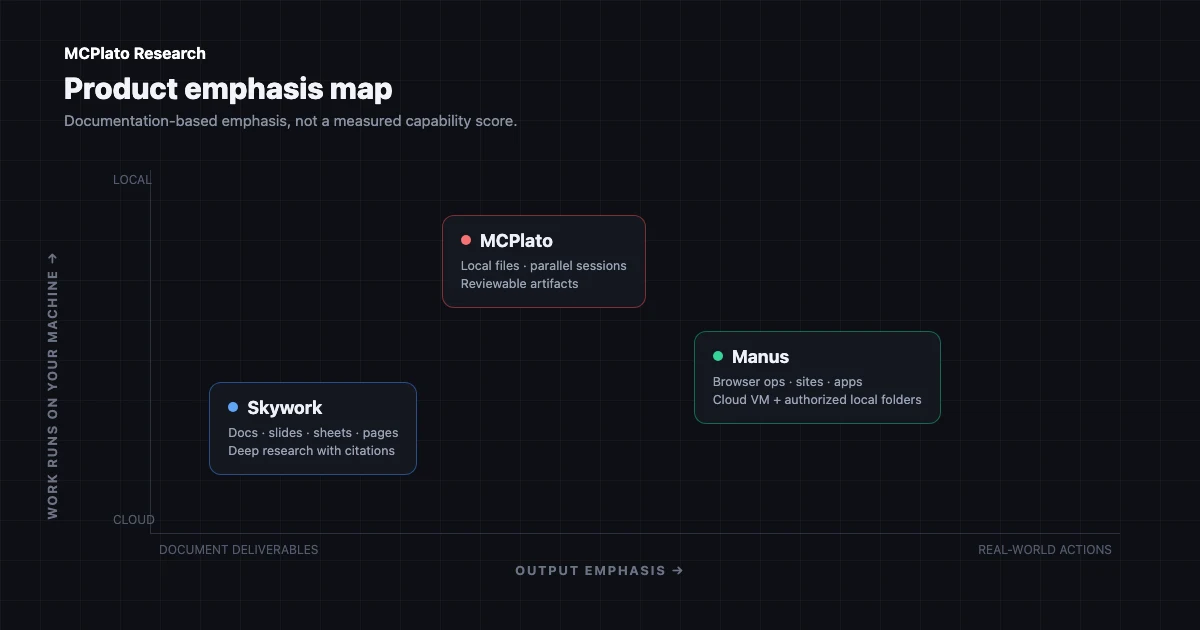 Skywork vs Manus positioning: office deliverables versus autonomous execution
Figure 1: A conceptual map of product emphasis based on official documentation — not a measured capability score.
Skywork: an office suite where every app is an agent
Skywork (by Skywork AI, launched globally in May 2025) organizes its product the way an office suite is organized. Instead of one chat box, you pick a specialist: Documents, Slides, Sheets — the "office trio" — plus web pages, podcasts, and a general agent.23
Two design decisions define it:
Everything sits on deep research. Skywork's agents research across sources and attach citations before they generate. The Slides agent, for example, lists "Deep Research & Citations" as a core feature alongside "Branded Templates" and "Auto Data Visuals," and exports to PPTX or Google Slides.4 For work where "where did this number come from?" is the first review question, citations-by-default is a real advantage over generic generators.
The deliverable is editable, not a screenshot. Outputs export to Word, PPTX, Excel, and other standard formats, and the suite has been consolidating into "OfficeSpace," billed as an AI-powered office suite.4
The boundaries to check before adopting:
- It is cloud-first. Your source material goes to a hosted service, and the work happens there. There is no local execution mode.
- Benchmark claims are vendor-published. Skywork's launch materials claim top scores on agent benchmarks such as GAIA; treat those as marketing until reproduced independently.2
- Credits meter real usage. Published pricing at the time of writing: a free tier (daily credits in the first month, then weekly) and a Pro plan around $19.99/month with a monthly credit allowance.5 Complex research tasks burn more credits; pilot with your real workload.
Manus: a general agent with its own computer — and now yours
Manus describes itself as a general AI agent and an "execution layer": you state a goal, and it plans and executes on a cloud virtual computer with web access, a file system, and the ability to install tools. By its own account it has created over 80 million virtual computers since launch.1
What distinguishes it in this pairing:
- Execution breadth. Manus builds websites and apps, produces slides and images, operates a browser for real actions (not just reading), and runs scheduled tasks. "Wide Research" fans a question out to parallel agents.6
- Local reach. Since March 2026, the Manus desktop app's "My Computer" feature lets the agent execute CLI commands on your machine: browsing and editing files in folders you explicitly authorize, building and debugging projects locally, even using your idle GPU. Commands require approval, with "Allow Once" / "Always Allow" scoping and sensitive operations confirmed per task.78
- Continuity. Projects, scheduled tasks, and connectors (Google Workspace, Slack, mail) keep recurring work inside the product.6
The boundaries to check:
- It is still a hosted agent. "My Computer" extends a cloud service onto authorized local folders; it does not make Manus a local-first product. The planning, the transcript, and most execution remain in the vendor's environment.
- Credit economics on long tasks. Autonomous multi-step runs are exactly the workloads that consume credits fastest. Define budgets per task type before rolling it out.
- Corporate flux. The December 2025 Meta announcement was followed by regulatory review in China and further ownership changes in 2026. For a business dependency, confirm the current operating entity, data jurisdiction, and support commitments at decision time.1
Head to head: the three questions that actually decide it
1. What does "done" look like?
If "done" is a document someone edits and presents, Skywork's specialist agents produce closer-to-final artifacts with citations attached. If "done" is a task completed in the world — a comparison researched and the form submitted, a site built and deployed — Manus's executor model fits better. A deck from Manus is one of many outputs; a deck from Skywork is the product.
2. Who is allowed to touch what?
Skywork's answer is simple: nothing on your machine, everything in its cloud. Manus's answer is more powerful and therefore requires more governance: browser actions, connectors into Google Workspace and Slack, and approved commands on authorized local folders. That reach is useful precisely because it is risky — treat folder authorizations and "Always Allow" grants as security policy, not convenience settings.
3. What does a month actually cost?
Both meter usage in credits, and credits are consumed by task complexity you cannot fully predict. The honest evaluation is identical for both: pick five representative tasks, run them for two weeks on a paid tier, and record credit burn, retry count, and how much human fixing the outputs needed. Sticker price differences are noise next to retry-heavy workflows.
To run that pilot without inventing a spreadsheet, download our reusable agent pilot scorecard (CSV) — it records the frozen configuration, repeated runs, weighted measures, and acceptance result per product, and works for hosted agents like these two just as well as for coding harnesses.
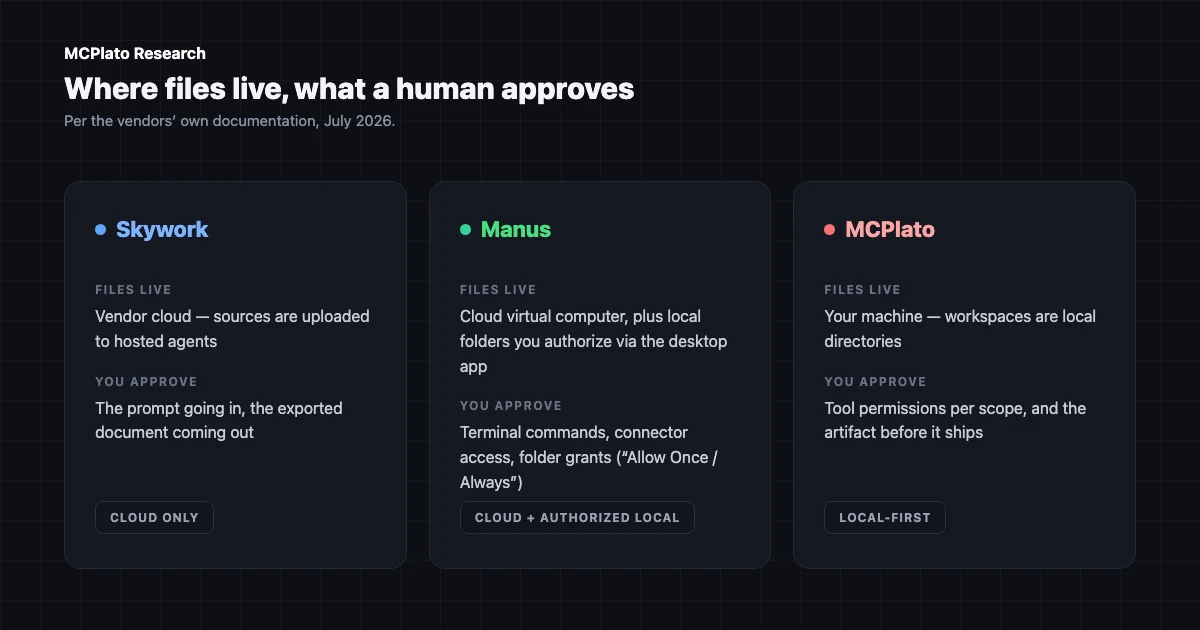 Data location and oversight: Skywork cloud, Manus cloud plus authorized local folders, MCPlato local-first
Figure 2: Where files live and what a human approves, per the vendors' own documentation.
Where MCPlato fits in this comparison
Skywork and Manus share one architectural assumption: the agent works in the vendor's cloud, and your materials go to it. For much personal and public-web work that is fine. It stops being fine when the inputs are client files, contracts, unreleased financials, or a codebase — or when you need several workstreams running in parallel with a human review gate before anything ships.
That is the job MCPlato is built for: a desktop workspace where agents work on local files with explicit permissions, sessions run in parallel per directory, and the output is a reviewable artifact rather than a hosted transcript.
- Recurring operations reports — the Manus scheduled-task pitch — as a local, reviewable routine: the product-ops use case.
- Research-to-deck with citations — the Skywork pitch — from a folder of your own materials: the consulting use case.
- Multi-format content production from local assets: the content-creator use case, with repeatable workflows packaged as Wands.
A realistic portfolio is not "one agent to rule them all": a hosted executor for public-web errands, an office-agent suite if cited documents dominate your output, and a local-first workspace for the work you would not paste into a chat box.
Final recommendation
- Use Skywork when your calendar is full of documents, decks, and spreadsheets, and citation-backed drafts would genuinely save hours.
- Use Manus when you want to delegate whole tasks — research plus action — and you are prepared to govern browser access, connectors, and local folder grants.
- Use MCPlato when data control, parallel sessions, and human-approved artifacts are requirements rather than preferences.
- Whatever you shortlist, run the same five real tasks on each for two weeks and measure credit burn, retries, and cleanup time. The winner is the one that reaches a reviewable result with the least hidden cost.
Official sources
Footnotes
-
Manus official announcement, "Manus Joins Meta for the Next Era of Innovation," December 29, 2025. https://manus.im/blog/manus-joins-meta-for-next-era-of-innovation ↩ ↩2 ↩3
-
Skywork AI launch announcement, "Skywork Launches Skywork Super Agents Globally," May 2025. https://www.prnewswire.com/news-releases/skywork-launches-skywork-super-agents-globally-the-ai-powered-office-suite-built-on-deep-research-302463133.html ↩ ↩2
-
Skywork official site: agent lineup and DeepResearch positioning. https://skywork.ai/ ↩
-
Skywork Slides agent official page: features and export formats. https://skywork.ai/agent/en/slides ↩ ↩2
-
Skywork published pricing and credit allowances (verify current terms). https://skywork.ai/ ↩
-
Manus official site: product features, Wide Research, browser operator, connectors. https://manus.im/ ↩ ↩2
-
Manus official blog, "Introducing My Computer: When Manus Meets Your Desktop," March 2026. https://manus.im/blog/manus-my-computer-desktop ↩
-
Manus documentation: Desktop and My Computer capabilities and approval model. https://manus.im/docs/features/desktop ↩