
From Group Tables to the Round of 32: How MCPlato Helps Fans Decode World Cup Qualification
A practical, source-cited workflow for using MCPlato to read official World Cup 2026 tables, apply the updated qualification rules, simulate final-round scenarios, compare third-place teams, and map possible Round of 32 opponents without pretending to predict matches.
If the final round of a World Cup group stage feels like a spreadsheet wearing a football scarf, that is because it is. One goal can flip a group winner, a second-place team, a third-place bubble team, and the likely Round of 32 opponent at the same time.
For World Cup 2026, the final competition runs from 11 June to 19 July 2026. The format makes that puzzle bigger: 48 teams, 12 groups of four, 104 matches, and a Round of 32 fed by the top two teams in each group plus the eight best third-placed teams. The useful question is not “what will happen?” It is: what happens if this scoreline happens?
This article is the English source for a localized guide that can later carry the title “From the standings to the Round of 32: how MCPlato helps fans calculate World Cup qualification.” The framing matters: scenario calculation, not match prediction. MCPlato should help fans, sports creators, and community operators read official data, apply official rules, test scoreline matrices, and publish cited explanations. It should not invent live facts, imply official FIFA integration, or dress a guess as certainty.
 Modern sports analytics dashboard over a football pitch showing abstract group tables and bracket paths
Start with official data, not vibes
The Researcher memo for this article was captured on the evening of 2026-06-23 in North American event-local time. At that time, FIFA’s official standings page was live and explicitly described standings as updated live during matches and subject to change while games are in progress. That single caveat should shape the whole workflow: every table in your draft must carry a source timestamp and timezone.
The core source set is straightforward:
- FIFA’s official standings page for the current table.
- FIFA’s official scores and fixtures page for remaining matches.
- The FIFA World Cup 26 Regulations PDF for tournament rules, including group ranking and best third-place criteria.
- FIFA’s explainer on groups, qualification, and tie-breakers.
- FIFA’s knockout-stage bracket article for the Round of 32 map.
- FIFA/Coca-Cola Men’s World Ranking, because the regulations use it as a later tie-break reference.
MCPlato can work from user-provided official pages, copied tables, screenshots that are verified against the page, or CSV files exported from a maintained standings sheet. The product claim should stay modest and accurate: this is a browser/file workflow under user control, not a promise of official FIFA live API access.
A practical MCPlato workspace stores each input with fields such as source_url, captured_at, timezone, retrieved_by, and notes. That way, a creator can say, “This scenario table uses FIFA standings captured at 2026-06-23 evening in North American event-local time; refresh before publication.”
The official qualification logic to encode
The basic points system is familiar: a win is worth three points, a draw one, and a loss zero. Each group has four teams. The top two teams in each of the 12 groups advance, then the eight best third-placed teams complete the Round of 32.
The final two matches in the same group are scheduled to kick off simultaneously unless FIFA decides otherwise. That matters because MCPlato should simulate the two remaining group matches together, not as isolated single-game hypotheticals.
The most important rules detail is also the easiest to get wrong. For World Cup 2026, the official group-ranking tie-breakers begin with head-to-head results among the tied teams. After that come all-group goal difference, all-group goals scored, Team Conduct Score, and FIFA/Coca-Cola Men’s World Ranking.
Do not use the older “overall goal difference first” mental model. Do not add an unofficial “drawing lots” ending. For this tournament, the workflow should convert the relevant regulation text into a checklist such as:
- Identify teams tied on points.
- Compare points obtained in matches among the tied teams.
- Compare goal difference in matches among the tied teams.
- Compare goals scored in matches among the tied teams.
- If still tied, compare all-group goal difference.
- Compare all-group goals scored.
- Compare Team Conduct Score.
- Compare FIFA/Coca-Cola Men’s World Ranking.
Team Conduct Score must also be encoded precisely: yellow card -1, indirect red card or second yellow -3, direct red card -4, and yellow card plus direct red card -5. MCPlato should keep this as a rules table, not a prose memory.
Best third-place ranking: the bubble table everyone argues about
The third-place comparison is where casual fans often lose the thread. The eight best third-placed teams advance. The ranking order is: points, all-group goal difference, goals scored, Team Conduct Score, then FIFA/Coca-Cola Men’s World Ranking.
In the Researcher memo’s timestamped example, FIFA had marked Mexico, USA, Germany, and Argentina as qualified. The same memo noted that if the table froze at the evening of 2026-06-23 in North American event-local time, the current third-place top eight would be Sweden, Scotland, Croatia, Algeria, Paraguay, Cabo Verde, Belgium, and Czechia, with Congo DR, Ecuador, Bosnia and Herzegovina, and Senegal on the bubble.
That paragraph is not a prediction. It is not even a durable fact. It is a snapshot example for explaining the workflow. A publishable MCPlato artifact should label it like this:
Snapshot example only: captured from official data around 2026-06-23 evening in North American event-local time. Refresh FIFA standings before publishing or sharing.
From there, MCPlato can generate a “freeze table” and then a scenario matrix: what changes if Group H’s third-place team gains one point, if Group C’s third-place team improves goal difference by two, or if two teams stay tied and Team Conduct Score becomes relevant?
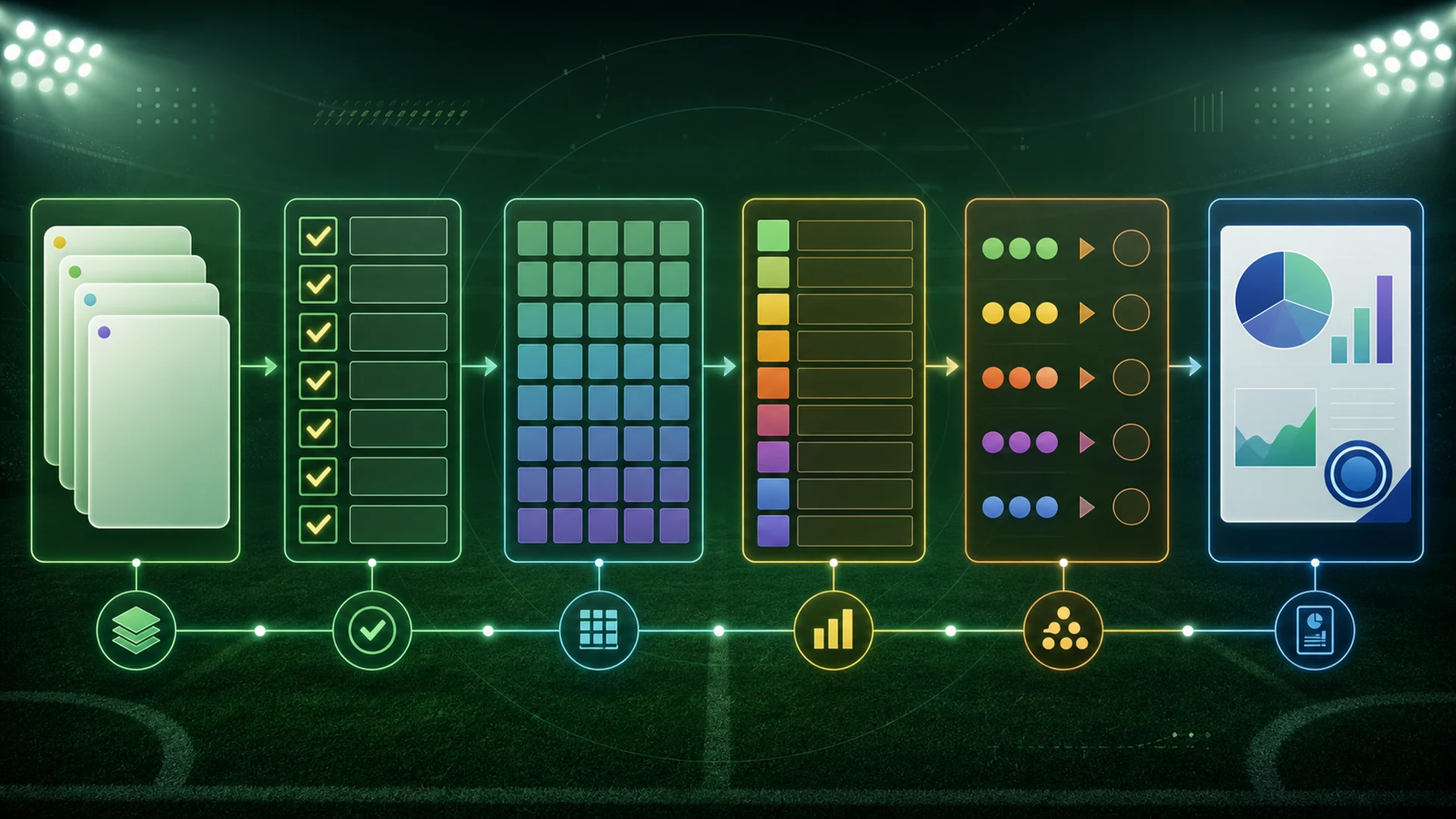 Workflow diagram showing official sources, rules checklist, scoreline simulations, standings recomputation, third-place comparison, and publishing artifacts
Round of 32 opponents: preset bracket, no new draw
After the 32 teams are known, the bracket is not invented on the fly. FIFA’s knockout-stage article lays out the Round of 32 schedule and bracket path. The official regulations also include an Annexe C allocation table for cases where different combinations of third-placed teams qualify.
That is why MCPlato should separate two tasks:
- Who qualifies? Apply group tables, tie-breakers, and best third-place ranking.
- Where do they go? Apply the pre-set bracket and Annexe C allocation logic.
The Researcher memo notes that Annexe C contains 495 possible combinations for allocating the eight best third-place source groups. In human terms, that means: once the best third-place teams come from, say, Groups A, C, D, F, H, I, J, and L, there is a pre-defined way to place those source groups into Round of 32 slots. There is no new draw to “avoid” a scary opponent.
For fans, this is the fun part. For creators, it is also the risky part, because a small qualification change can alter an entire opponent path. MCPlato’s job is to generate a cited bracket view with a caveat: “potential opponent under this scenario,” not “confirmed opponent” unless FIFA has confirmed it.
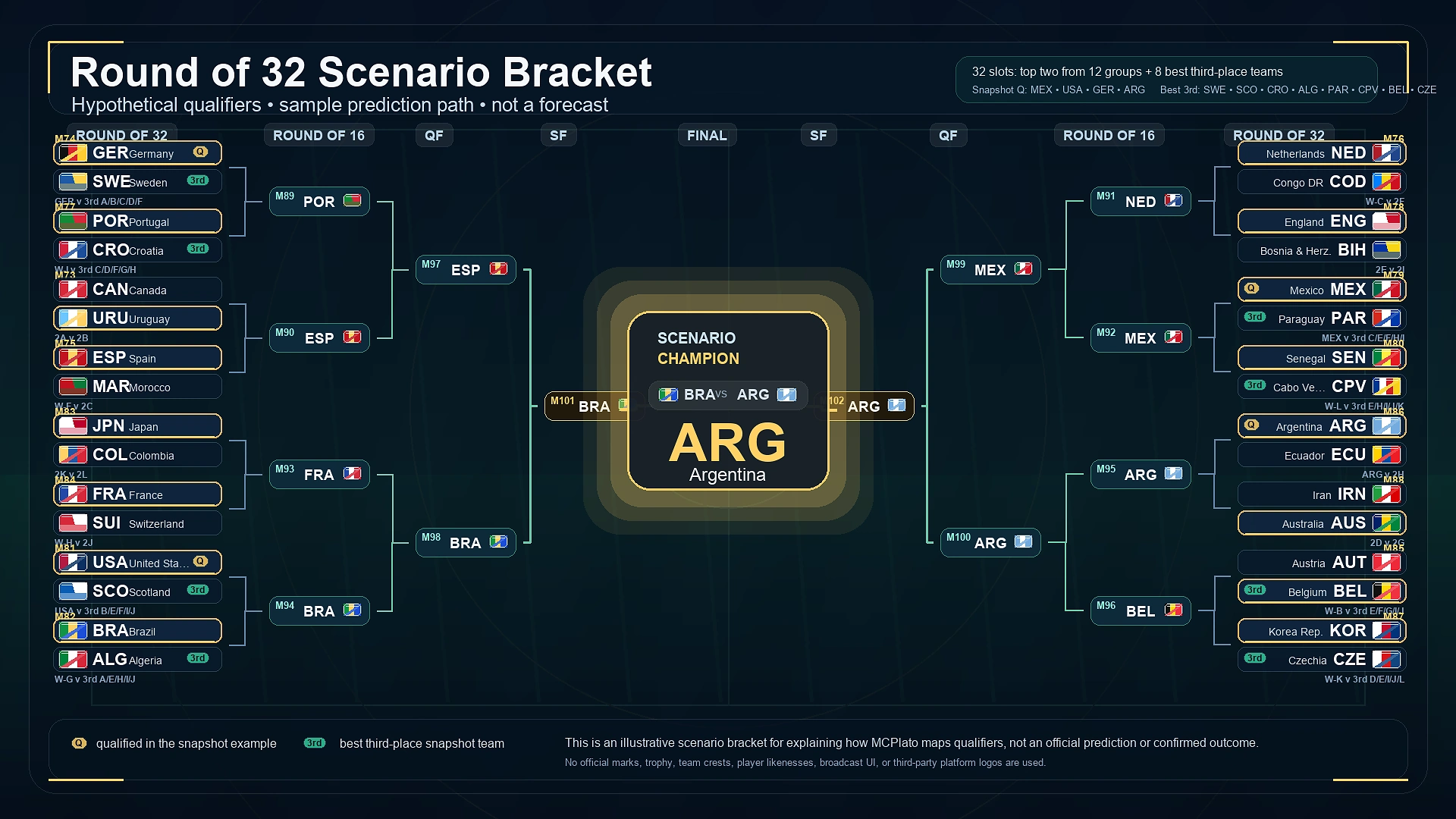 Hypothetical Round of 32 scenario bracket showing 32 qualifier slots, sample predicted countries, and paths to the final
A concrete MCPlato workflow for fans and creators
Here is a practical workflow that stays grounded in official data.
1. Ingest the source pack. Ask MCPlato to read the FIFA standings page, scores/fixtures page, regulations PDF, rules explainer, knockout bracket article, and FIFA ranking page. If live page extraction is inconsistent, paste the tables or provide a CSV. MCPlato should record source URL and timestamp for every input.
2. Turn rules into a checklist. Convert the relevant regulation text into a machine-checkable checklist: group ranking, Team Conduct Score, best third-place ranking, simultaneous final-round scheduling, and Annexe C mapping. Keep the checklist visible so the user can approve it before simulations begin.
3. Build the last-round scoreline matrix. For each group, simulate both final matches together. The matrix can be coarse, such as home win/draw/away win, or numeric, such as 0-0 through 4-4. The output should show how the group winner, runner-up, and third-place team change.
4. Recompute the group table. For each scenario, MCPlato recalculates points, head-to-head tie-breakers, all-group goal difference, goals scored, Team Conduct Score, and ranking fallback only when needed. It should expose the reason for each placement.
5. Compare the 12 third-place teams. MCPlato creates a best-third table for every scenario. The key output is not only the top eight, but also the bubble: which teams are one goal, one point, or one conduct-score step away from changing the bracket.
6. Apply the bracket and Annexe C. Once the qualifying source groups are known, MCPlato maps each team into the pre-set Round of 32 slots. If the source combination changes, the artifact should show which bracket cells changed and why.
7. Generate publishable artifacts. MCPlato can draft a matchday explainer, social post thread, FAQ, creator script, community update, and image brief. For ClawMode, a scheduled refresh can remind the operator to re-check official pages before kickoff or before publishing. Permission checkpoints matter: refresh, rewrite, and publish should be separate steps.
Who benefits from this?
Ordinary fans get a clear answer to “what do we need?” without reading a regulation PDF mid-match. A fan can ask, “If we draw 1-1 and the other match ends 2-0, do we finish second or third?” MCPlato returns the table, the tie-break reason, and the next possible opponent.
Sports content creators get a repeatable production line. Instead of hand-editing a graphic every time a goal changes, they maintain a source-linked scenario table and regenerate the explainer after refreshing the standings.
Community operators get calm, cited updates for group chats. They can publish “confirmed,” “likely under this scenario,” and “still unresolved” sections, which reduces rumor loops during simultaneous kickoffs.
Across all three audiences, the principle is the same: scenario calculation, not match prediction.
Copyable prompts
Use these prompts as starting points. Replace bracketed fields with your own sources and constraints.
-
Prompt 1
Read these official World Cup 2026 sources: [standings URL], [scores/fixtures URL], [regulations PDF], [groups/tie-breaker explainer], [knockout bracket article], and [FIFA ranking URL]. Store the source URL, capture timestamp, and timezone for each. Do not infer live facts that are not visible in the sources.
-
Prompt 2
Convert the World Cup 2026 group ranking, best third-place ranking, Team Conduct Score, and Round of 32 allocation rules into a checklist. Pay special attention that group-ranking tie-breakers start with head-to-head among tied teams, then all-group goal difference/goals scored/Team Conduct Score/FIFA ranking. Do not use an old overall-goal-difference-first flow.
-
Prompt 3
Using the standings captured at [timestamp/timezone], simulate the final two matches in Group [X] together. Test scorelines from 0-0 to 4-4. For each scenario, recompute the group ranking, explain the tie-breaker used, and label the output as scenario calculation, not match prediction.
-
Prompt 4
Compare all 12 third-placed teams under this scenario. Rank them by points, all-group goal difference, goals scored, Team Conduct Score, and FIFA ranking. Show the top eight, the bubble teams, and the smallest result changes that would alter qualification.
-
Prompt 5
Apply the official Round of 32 bracket and Annexe C allocation for the qualifying third-place source groups. Produce a fan-friendly explanation of potential opponents, but mark every unconfirmed slot as provisional.
-
Prompt 6
Draft a publishable community update for ordinary fans. Include: source timestamp, confirmed qualifiers, unresolved scenarios, third-place bubble, potential Round of 32 opponents, caveats, and a reminder to refresh FIFA data before posting.
CTA: make the final round readable
The last group-stage round is not just about watching matches. It is about understanding a moving rule system under time pressure. MCPlato turns that chaos into a cited workflow: official sources in, rules checklist approved, scoreline scenarios simulated, third-place bubble compared, bracket path mapped, and publishable explanations generated with human checkpoints.
Use MCPlato as a sports scenario desk, not a prediction oracle. Let it do the careful arithmetic. You keep the editorial judgment.