
Why Agents Are Partners, Not Tools: From Prompts to Loops
AI is evolving from a question-answering tool into an autonomous working partner. This article explores the architectural shift from prompt engineering to trustworthy loops, and how MCPlato encapsulates this new paradigm with Wand, Sprite, and Artifact.
The prompt is no longer the product. For most of the last three years, getting value from AI meant getting the prompt right: chaining examples, tuning temperature, praying the model would not hallucinate a citation. The interface was a chat box; the contract was question → answer. That contract is now breaking, and the replacement is not a better prompt. It is a loop.
Anthropic defines an agent as an LLM that uses tools based on environmental feedback in a loop. OpenAI's Agents SDK puts the loop at the center of execution. Microsoft describes AI evolving from instrument to partner. MindStudio calls ours the "post-prompting era." These are not marketing rebrands. They describe a real architectural shift: from a model that answers you to a system that keeps working after you stop typing.
{/* i18n-ignore-next-line */} That shift has a name. We call it partner, or in Chinese, 虚拟员工 — virtual employee. A partner is not a sharper search engine or a faster autocomplete. It is an entity with state, memory, initiative, and accountability for a durable outcome. The question is no longer "What prompt gets the best answer?" It is "What loop produces a result I can trust and build on?"
The Old Contract: AI as Tool
Under the tool contract, the human does all the context assembly. You write the prompt, upload the files, explain the constraints, and the model returns a block of text. If the answer is wrong, you rewrite the prompt. If the context is incomplete, you paste more context. The model is stateless by default; each turn is a fresh transaction. The value comes from compression: a good answer to a well-formed question.
This contract created an entire discipline of prompt engineering — and a hidden tax. A 2026 CIODive report found that knowledge workers now spend roughly one hour making AI output usable for every hour of useful output they get from AI. The tool contract hides that cost because the human is busy cleaning up after a system that cannot reason across turns.
The tool contract is not going away. Search, summarization, and coding assistance still benefit from a great prompt. But it is no longer the ceiling. Once a task requires more than a few turns, more than one tool, or live feedback, the prompt becomes the bottleneck. You are no longer asking for an answer; you are trying to script a process inside a single text box.
The New Contract: AI as Partner
The partner contract starts from a different assumption: the human provides intent, context, and boundaries, and the agent does the rest. It senses the environment, plans a sequence of actions, acts through tools, observes the result, and loops. It remembers what happened. It retries when something fails. It escalates when it hits a boundary.
This is why vendors increasingly describe agents as teammates. Anthropic reports that, as of May 2026, more than 80% of its merged code is authored by Claude. PwC's 2025 AI Agent Survey finds that early adopters report 66% productivity gains. Salesforce's 2025 State of Service Report says agents handled 30% of service cases in 2025, with a projection of 50% by 2027, and reduced routine-case time by 20%.
These numbers do not mean agents are infallible. They mean the work product has changed. A partner does not just return text; it returns a state change in the world: a ticket closed, a test passing, a report filed, a message posted. The human role shifts from operator to reviewer, from doer to delegator.
From Prompts to Loops
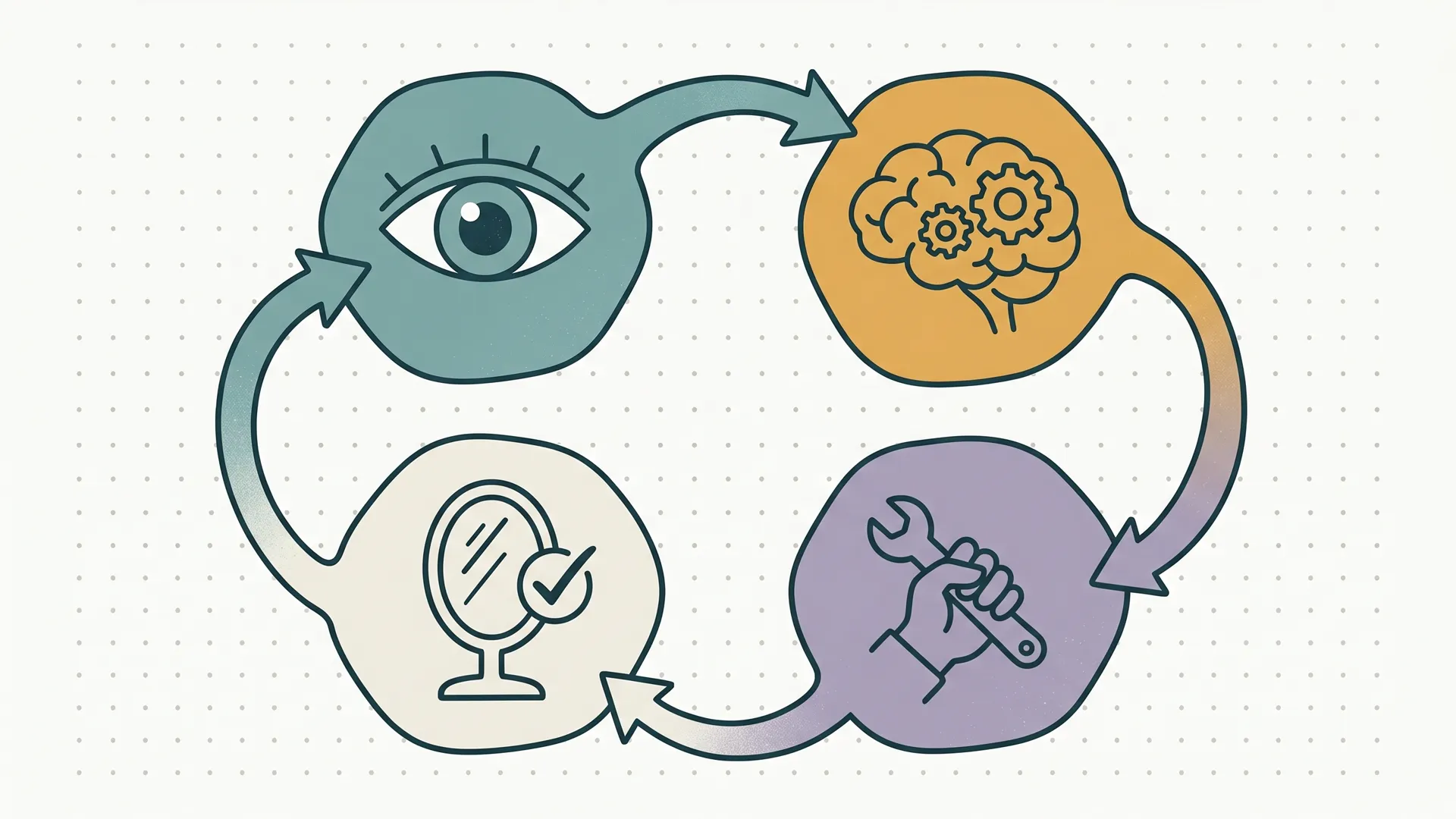
The canonical agent loop is sense → plan → act → observe. Microsoft describes a seven-step perception-action cycle for autonomous agents. MIT Sloan's "Agentic AI, Explained" emphasizes that agents perceive, reason, and act on their own. MindStudio's post-prompting thesis argues that the future belongs to proactive agents that initiate work rather than waiting to be asked.
What makes the loop different from a chain of prompts is feedback. In a prompt chain, the human is the feedback mechanism. In a loop, the environment is. The agent reads a file, runs a test, sees an error, and tries a fix. It checks a database, notices a missing record, and creates it. Each cycle narrows the distance between intent and outcome without requiring the human to re-explain the goal.
The loop also changes what information the agent uses. Under the tool contract, the prompt is the entire input. Under the partner contract, it is one signal among many: files, APIs, databases, previous runs, team messages, and real-time events. The agent is a function of its environment, with your prompt as the objective function.
This is the real meaning of "no longer writing prompts, but writing loops." The craft moves from rhetoric to architecture. You are designing a control system, not a query.
Why This Changes the Work Product
A tool delivers an answer. A partner delivers an artifact. The difference matters because answers are ephemeral and artifacts are durable.
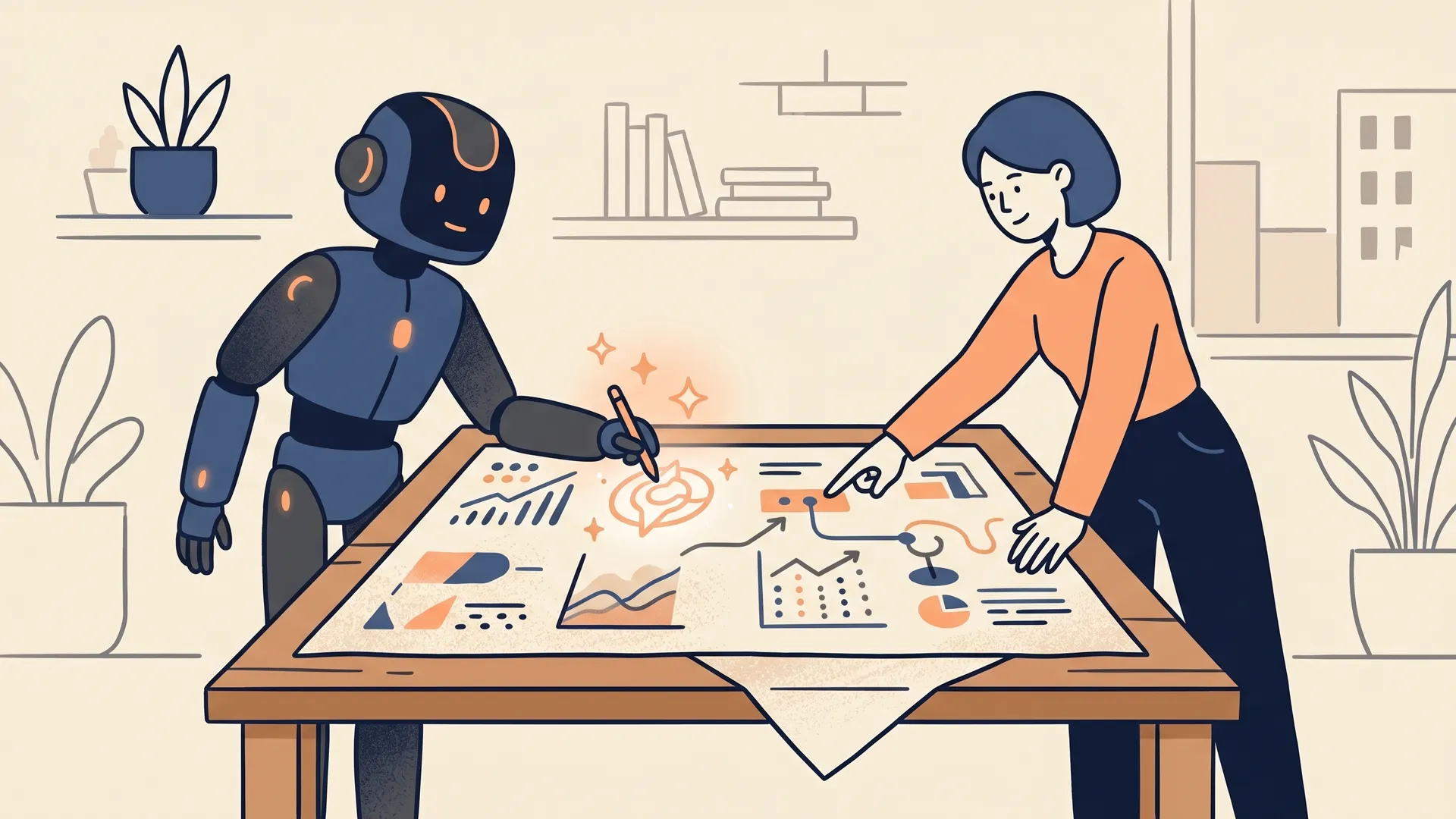
An answer lives in the chat window. An artifact lives in your workspace: a document, a codebase change, a test suite, a design file, a structured report. It can be reviewed, versioned, shared, and improved. It carries context forward so the next human — or the next agent — does not start from zero.
The artifact is also the boundary of trust. When an agent changes a file, you can diff it. When it writes a report, you can check its sources. When it posts to Slack, your team can challenge it. Artifacts make agency legible. Without them, the loop is just a longer chat.
This is where most current productivity discussions miss the point. The gains from agents do not come from typing faster; they come from asynchronous completion. The agent works while the human sleeps, meets, or focuses on something else. The deliverable is waiting when the human returns. That only works if the deliverable is inspectable and actionable.
MCPlato's Approach: Packaging the Loop
MCPlato was built around the partner assumption. The basic unit is not a chat message; it is a loop that produces a durable artifact.
Wand is that loop, packaged. A Wand is a reusable, versionable workflow that defines phases, per-phase prompts, gate checks, a tool allowlist, and a runtime view. It breaks work into discrete phases and advances only when a gate passes — reading files, calling APIs, asking for clarification, writing the final artifact. The Wand is the architectural answer to "how do I write a loop instead of a prompt?"
Partner / Sprite is the workspace-level orchestrator. If a Wand is a packaged process, a Sprite is the manager that decomposes larger tasks and dispatches worker sessions on the user's behalf. It is a team of agents working toward an outcome the human defined: set the objective, approve checkpoints, review the artifact.
Skill / Distill Skill captures recurring workflows as reusable instructions. When a Sprite solves a problem once, MCPlato can distill that execution into a Skill so the same pattern runs again without reinventing the prompt.
Local-first + Permission Framework makes the partner trustworthy enough to leave running. Sensitive data stays on the user's machine by default, and fine-grained permission modes limit what a loop can see and do.
Model Routing + Cost Control reserves expensive reasoning for the phases that need it. A simple extraction phase runs on a cheap, fast model; a complex planning phase escalates to a larger model. Intelligence is matched to difficulty.
IM Bridge + Durable Deliverables extend the loop into the tools teams already use. Slack, Discord, Telegram, Feishu, WeChat, WeCom, and QQ become asynchronous delegation interfaces. The agent reports progress and delivers an Artifact — a structured, versionable document-package — not a wall of chat text.
 Abstract flat illustration of a hand-drawn loop arrow transforming a static command into a living partner figure in a modern workspace
Tool vs Partner
The table below summarizes the architectural differences. The shift is not about model size or interface polish. It is about who holds state, who initiates action, and what gets left behind.
| Dimension | AI as Tool | AI as Partner |
|---|---|---|
| Input | A single prompt, fully specified by the human | Intent plus environmental signals; prompt is one input among many |
| Execution model | Request → response, stateless | Sense → plan → act → observe, stateful loop |
| Memory | None across turns unless manually re-pasted | Persistent state, checkpointing, and cross-session context |
| Deliverable | Ephemeral answer in a chat window | Durable Artifact: file, report, code change, or structured package |
| Cost model | Per-query; cheaper but repeated manually | Per-loop; cheaper subtasks routed to smaller models |
| Failure mode | Wrong answer, ignored | Wrong action, repeated loop, tool misuse; requires guardrails |
| Human role | Operator, prompt writer, output polisher | Delegator, reviewer, governance designer |
The last row is the hardest to accept. Most people got good at AI by getting good at prompts. The next competence is designing systems that can be left alone.
Risks and Governance
A partner without governance is not an employee; it is a liability. The 2026 IBM study on the AI control gap is sobering: 77% of CIOs and CTOs say AI adoption is outpacing governance, 89% say their organizations are not fully prepared for agentic AI, and enterprises report an average of 54 agent-related incidents per year. The same autonomy that makes agents productive also makes them dangerous.
Microsoft Security's June 2026 update reports 99 CVEs related to the Model Context Protocol in 2025. The attack surface is no longer the model's weights; it is the tools the agent can call, the permissions it carries, and the data it can reach.
This is why the partner metaphor is not just aspirational; it is a governance requirement. A real employee has a role, a scope, a manager, and an audit trail. An agent partner needs the same: explicit permission boundaries, mandatory checkpoints for irreversible actions, observable runtime state, and versionable artifacts.
 Flat hand-drawn editorial illustration of an agent partner and a human collaborating over a durable document artifact
Conclusion: Design the Loop, Not the Prompt
The industry is converging on a new contract. Agents are no longer tools that answer questions; they are partners that complete work. The evidence is accumulating, even if the numbers are uneven.
For builders, the implication is practical. Stop trying to write the perfect prompt. Start designing the loop: what the agent senses, how it plans, which tools it can use, what gate checks keep it safe, where it must pause for a human, and what artifact it produces. The craft of AI engineering is becoming the craft of trustworthy autonomy.
MCPlato's bet is that this autonomy is best expressed as packaged, observable, local-first loops: Wands as reusable processes, Sprites as orchestrators, Skills as distilled expertise, and Artifacts as durable deliverables. The future is not a better chatbot. It is a virtual employee that shows up and leaves something you can review in the morning.
FAQ
What is the difference between an AI tool and an AI partner? A tool answers a prompt and waits. A partner runs a continuous loop, maintains state and memory, uses tools on its own initiative, and delivers durable artifacts.
Why is "the loop" more important than the prompt? A prompt is one-shot. A loop lets an agent gather information, reason about feedback, retry failures, and keep working while the human is away.
What does MCPlato mean by a Wand? A Wand is a packaged, reusable loop: a multi-phase workflow with prompts, gate checks, tool allowlists, and a runtime view.
How does MCPlato keep a partner agent trustworthy? Through local-first execution, fine-grained permissions, explicit gate checks, model routing, durable checkpoints, and human final approval for high-stakes actions.
Are agents replacing employees? Current evidence points to augmentation, not wholesale replacement. Roles shift toward managing, verifying, and improving agent output.
What are the main risks of agent-as-partner? Autonomy without governance leads to incidents, permission misuse, and security exposure. Governance must be designed into the loop from the start.
How do I start designing for agents instead of prompts? Define the loop: sense, plan, act, observe, checkpoint, artifact. The prompt becomes one constraint inside a larger control system.
References
- Anthropic. "Building Effective Agents." December 2024. https://www.anthropic.com/research/building-effective-agents
- OpenAI. "Running agents." OpenAI Agents SDK, 2025. https://developers.openai.com/api/docs/guides/agents/running-agents
- Microsoft. "What's next in AI: 7 trends to watch in 2026." December 2025. https://news.microsoft.com/source/features/ai/whats-next-in-ai-7-trends-to-watch-in-2026/
- Microsoft. "What are autonomous AI agents?" Microsoft Copilot 101, 2025/2026. https://www.microsoft.com/en-us/microsoft-copilot/copilot-101/autonomous-ai-agents
- MindStudio. "The Post-Prompting Era: Proactive AI Agents." April 2026. https://www.mindstudio.ai/blog/post-prompting-era-proactive-ai-agents
- MIT Sloan. "Agentic AI, Explained." February 2026. https://mitsloan.mit.edu/ideas-made-to-matter/agentic-ai-explained
- Anthropic. "Recursive Self-Improvement." May 2026. https://www.anthropic.com/institute/recursive-self-improvement
- PwC. "AI Agent Survey." May 2025. https://www.pwc.com/us/en/tech-effect/ai-analytics/ai-agent-survey.html
- Salesforce. "2025 State of Service Report." November 2025. https://www.salesforce.com/news/stories/state-of-service-report-announcement-2025/
- IBM. "New IBM study finds CIOs and CTOs face growing AI control gap as enterprise deployment scales." June 2026. https://newsroom.ibm.com/2026-06-08-new-ibm-study-finds-cios-and-ctos-face-growing-ai-control-gap-as-enterprise-deployment-scales
- Microsoft Security. "Updating taxonomy and failure modes for agentic AI systems: a year of red teaming taught us." June 2026. https://www.microsoft.com/en-us/security/blog/2026/06/04/updating-taxonomy-failure-modes-agentic-ai-systems-year-red-teaming-taught-us/
- CIODive. "Workers spend more time managing AI." 2026. https://www.ciodive.com/news/workers-spend-more-time-managing-ai/822554/