MCPlato vs NotebookLM: From Source-Grounded Notes to Local-First Research Workflows
NotebookLM is excellent for source-grounded learning, citations, Audio and Video Overviews, and student study artifacts. MCPlato complements it when research must become local files, workflow artifacts, multi-session execution, automation, and permissioned follow-through.
Short answer: NotebookLM is one of the best products for learning from a curated source set. MCPlato is not trying to beat it at that job. The better question is what happens after a researcher understands the sources. If the next step is a local report, spreadsheet, PDF, web page, browser operation, recurring brief, approval path, or multi-session workstream, MCPlato becomes the more natural operating layer.
Google positions NotebookLM as a source-grounded AI notebook for organizing sources, asking questions, generating citations, and creating learning artifacts. Its Workspace page highlights grounded answers, source management, summaries, Audio Overviews, Video Overviews, and enterprise availability.Google Workspace: NotebookLM Support documentation explains that NotebookLM answers are grounded in the sources a user adds to a notebook, with citations back to source passages.NotebookLM source-grounded answers and citations
That is a strong position. NotebookLM is compelling for students, analysts, researchers, and teams who want to understand a source pack without losing the thread. Google has expanded it with Audio Overviews, Video Overviews, Mind Maps, student features, Discover Sources, Deep Research and expanded file types, a mobile app, and Workspace or Enterprise surfaces.Audio Overviews Video Overviews Mind Maps Student features Discover Sources Deep Research and file types NotebookLM mobile app NotebookLM Enterprise
So the comparison should not say “MCPlato replaces NotebookLM” in every situation. A more honest frame is this: NotebookLM is excellent for source-grounded learning; MCPlato complements or replaces it when the unit of value becomes a work artifact and a workflow.
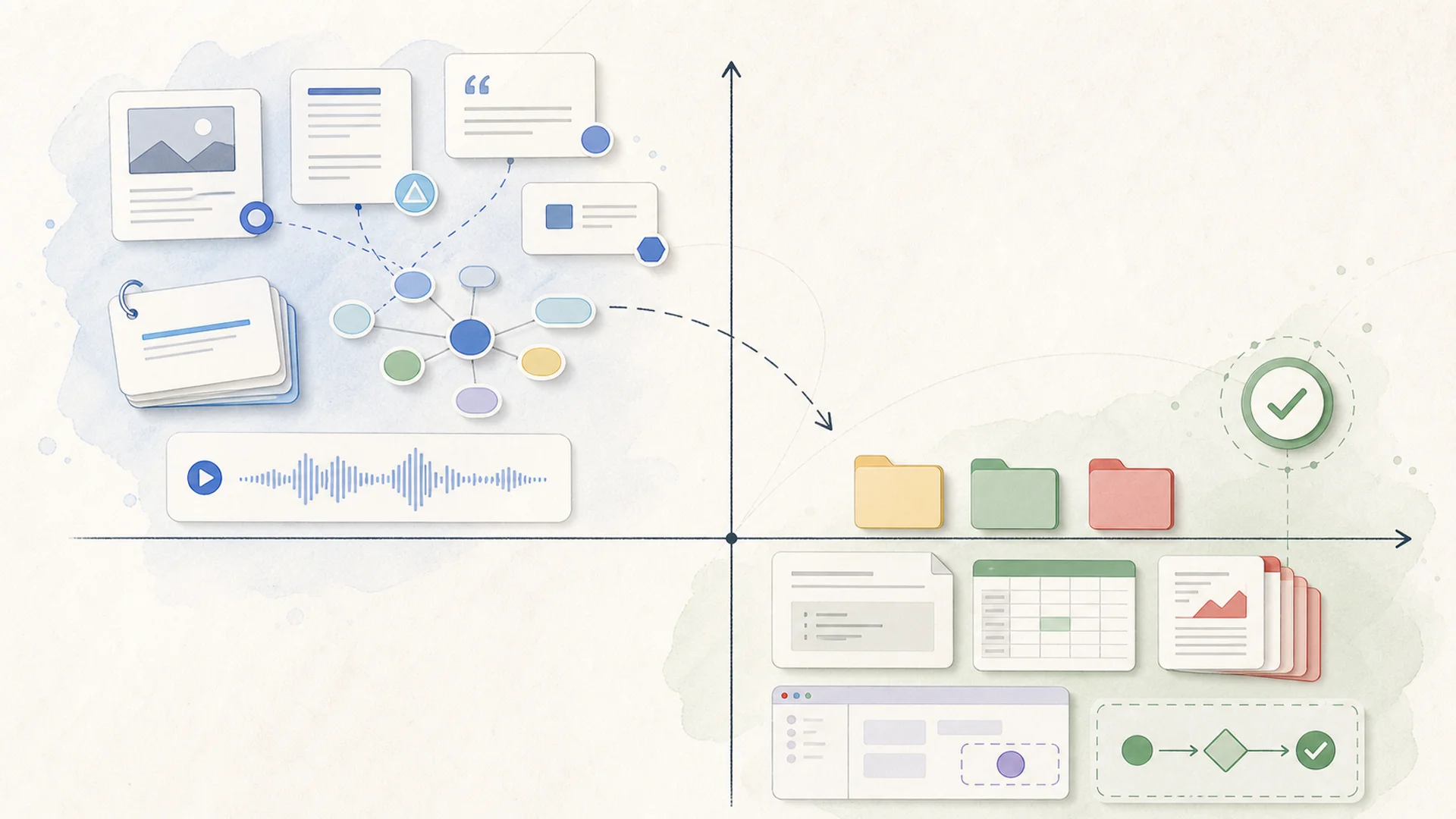 Editorial comparison between source-grounded learning and local-first artifact execution
Figure 1: NotebookLM is strongest when the task is to understand and cite sources. MCPlato is strongest when the task becomes local files, artifacts, permissions, and execution. The illustration is editorial only and uses no official logos or product UI.
What real users are asking for
The demand signal around NotebookLM is not simply “make the AI smarter.” Public user discussions point to operational needs around export, automation, local notes, more source types, persistent research chains, and control over sensitive material.
On the Google AI Developers Forum, users have asked for a NotebookLM API and described automation use cases that resemble n8n, Zapier, Make, and custom workflow integration.NotebookLM API demand On Hacker News, some users praised NotebookLM's power while asking for broader source handling, better Audio Overview controls, and improvements to directing generated outputs.HN: NotebookLM is powerful and feature requests In another Hacker News discussion about designing NotebookLM, users discussed export, history, UI, notes, sensitive-data concerns, and a business scenario where a consultant summarizes sales meeting transcripts and a statement of work, then turns that knowledge into kickoff decks or management reports.HN: Designing NotebookLM discussion
Those are not universal complaints, and they do not erase NotebookLM's strengths. They show a pattern: once users trust a source-grounded assistant, they quickly want it to participate in the rest of their work system.
Need 1: From understanding sources to shipping work artifacts
Real need: “I understood the sources. Now I need an editable report, spreadsheet, PDF, web page, or client-ready package.”
NotebookLM is built for source-grounded synthesis. It helps users ask questions, follow citations, create summaries, generate Audio and Video Overviews, and produce study artifacts. For a student reading dense papers or a policy analyst reviewing a document pack, that is a major advantage. It also has plan differences across notebooks, sources, source size, chat queries, generated reports, flashcards, quizzes, Mind Maps, overviews, and Deep Research allowances.NotebookLM limits NotebookLM limits and availability Google AI subscriptions Google One AI plans
But many professional workflows do not end with understanding. A PM may need a competitive matrix and launch memo. A consultant may need a kickoff deck and management report. An operations lead may need a weekly brief sent to a channel. The HN consultant example is useful because it moves from “summarize sources” to “produce business artifacts.”HN: Designing NotebookLM discussion
MCPlato's public positioning starts from the next step: a Desktop AI Engine that can read, write, execute, and iterate locally.MCPlato homepage In practice, that means the research result can become a Markdown file, report draft, spreadsheet, PDF package, image set, web artifact, or file operation under user control. NotebookLM wins when the primary deliverable is source-grounded understanding. MCPlato wins when the deliverable is a work product that must be edited, saved, rerun, or delivered.
Need 2: Local directories and native-first work
Real need: “My sources are not just uploaded PDFs. They are folders, Markdown notes, screenshots, code-adjacent repositories, spreadsheets, and messy local projects.”
NotebookLM has expanded supported source types and Deep Research, and its Google Drive or Workspace onboarding can be very convenient for users already living in Google's ecosystem.Deep Research and file types For source packs that fit the notebook model, that is a clean experience.
The pressure appears when the user's working set is already a directory. Public feedback asks for more source types, better source handling, local notes, export, and continuity across research chains.HN: NotebookLM is powerful and feature requests HN: Designing NotebookLM discussion
MCPlato's “Directory as Conversation” idea addresses this from the opposite direction: the folder itself becomes the workspace, with persistent context around files and prior work.Directory as Conversation That matters when the source of truth is not a notebook but a project directory: PDFs beside notes, exports beside spreadsheets, screenshots beside drafts, or a codebase beside documentation. Native-first does not solve every compliance question automatically. It means the user's local work surface can remain the center of gravity instead of being re-uploaded or manually reconstructed.
Need 3: Multi-window and multi-session research
Real need: “This is too complex for one notebook thread. I need parallel sub-research, separate drafts, and a way to keep workstreams from colliding.”
NotebookLM's notebook metaphor is useful because it keeps a source set together. But complex work often branches. A market-entry project may require one thread for regulation, another for competitors, another for customer interviews, another for financial modeling, and another for the executive memo. In public discussion, users asked for better history and continuity as research gets longer and more iterative.HN: Designing NotebookLM discussion
MCPlato's multi-session and Parallel Tabs model is better suited to that style of work. Instead of stretching one conversation into every subtask, a user can run multiple AI conversations around the same workspace: one session reads sources, another drafts a memo, another checks a spreadsheet, another operates a browser, and another prepares a deliverable. This does not mean MCPlato has better source citations than NotebookLM. It is a workflow claim: when research becomes coordinated tasks, session separation becomes a feature.
Need 4: Automation, API-like workflows, browser operation, and scheduled tasks
Real need: “I want the research process to run on a trigger, connect to tools, operate websites, ask for approval, and deliver results back to where my team works.”
The forum demand for a NotebookLM API shows that users want NotebookLM-like intelligence inside larger automations, not only inside a notebook UI.NotebookLM API demand NotebookLM Enterprise exists, but teams should not confuse that with a broad consumer public API for every NotebookLM use case.NotebookLM Enterprise
MCPlato's ClawMode is designed around this “AI partner in the workflow” pattern: channel input, workspace context, tools and tasks, approval for sensitive actions, and result delivery back to the channel.MCPlato ClawMode MCPlato also emphasizes browser operation, scheduled tasks, multimodal understanding and generation, and local multi-session execution at the product level.MCPlato homepage
That matters for recurring work. An operations team may want an industry brief every Monday. A founder may want a browser task that checks competitor pages and updates a local comparison table. A consultant may want meeting transcripts and SOWs converted into a kickoff package, with approval before sending. NotebookLM can help understand the materials; MCPlato is better positioned to run the surrounding workflow, including scheduled tasks.
Need 5: Reusable workflows with Wands, Distill, and Skills
Real need: “I do not want to reinvent the same research-to-artifact process every week.”
The most valuable AI workflow is rarely the one-off prompt. It is the pattern that can be repeated with new inputs: student paper review, PM competitive research, consulting kickoff package, weekly industry brief, sales-call-to-report pipeline, or website research to content draft. Public discussions around export, automation, and consultant workflows suggest that users want repeatable systems, not isolated answers.NotebookLM API demand HN: Designing NotebookLM discussion
MCPlato's Wand, Distill Wand, and Skill concepts should be understood at a high level: a way to turn a proven workflow into a reusable pattern. The public product language around skills, Distill, and workflow operation supports the idea that users can teach, package, and rerun work rather than reconstructing the same instructions.MCPlato homepage MCPlato ClawMode This is especially useful when the output requires multiple phases: collect sources, extract evidence, draft, generate visuals, validate, ask for approval, and deliver.
Need 6: Privacy posture, permissions, and cost discipline
Real need: “Some materials are sensitive, and I need control over what the AI reads, writes, sends, or executes.”
Some users in public discussions raised concerns about sensitive material and control.HN: Designing NotebookLM discussion NotebookLM has Workspace and Enterprise options, and organizations should evaluate those directly against their policies.Work or school account access NotebookLM Enterprise MCPlato's safer claim is narrower: it is local-first in orientation, works with files on the user's computer, and uses permission levels and approval moments before sensitive actions.MCPlato homepage MCPlato ClawMode
Cost should also be framed carefully. NotebookLM has plan-specific limits and Google AI subscription surfaces; MCPlato's homepage offers a “Download Free” personal entry point and describes free personal use.MCPlato homepage The better economic question is not “which tool is cheaper by subscription label?” It is “which tool reduces repeated context setup, export friction, manual copy-paste, and unfinished work?” For artifact-heavy workflows, those hidden costs often dominate.
 Workflow from sources to notes, artifacts, approval, channel delivery, and scheduled follow-up
Figure 2: A local-first research workflow can move from sources to notes, artifacts, approval, channel delivery, and scheduled follow-up. No platform logos or official UI are shown.
Four concrete workflows
Student reading papers. Start with NotebookLM when the student needs source-grounded Q&A, citations, Mind Maps, flashcards, quizzes, Audio Overviews, or Video Overviews. Switch to MCPlato when the student needs a local literature review, annotated Markdown library, formatted PDF handout, or recurring study workflow.
PM competitive research. Use NotebookLM to understand a curated set of product docs, launch notes, and customer interviews. Use MCPlato to turn findings into a comparison matrix, roadmap memo, browser-checked update, and stakeholder-ready report.
Consultant kickoff package. Use NotebookLM to summarize transcripts, SOWs, and reference material. Use MCPlato when the job becomes a kickoff deck, management report, risk register, spreadsheet, PDF pack, and approval-controlled client delivery.
Operations industry brief. Use NotebookLM for deep understanding of a source pack. Use MCPlato when the workflow should run on a schedule, browse sites, update files, ask for review, and post a digest back to a channel.
Decision rule
Choose NotebookLM when the center of gravity is learning from sources. Choose MCPlato when the center of gravity is turning sources into local, inspectable, repeatable work. Use both when the workflow begins with grounded understanding and ends with a deliverable that must live in your file system or team process.
FAQ
Is MCPlato a full replacement for NotebookLM?
No. NotebookLM remains stronger for source-grounded Q&A, citations, notebook organization, Audio Overviews, Video Overviews, Mind Maps, student study artifacts, and Google Drive or Workspace onboarding. MCPlato is better when research must become local files, artifacts, workflows, browser operations, scheduled tasks, approvals, and reusable patterns.
Where does NotebookLM clearly win?
NotebookLM wins in curated-source learning, citation UX, study flows, Audio and Video Overviews, Mind Maps, student features, Discover Sources, mobile access, and Google ecosystem convenience.
Where does MCPlato clearly win?
MCPlato wins when the task involves local folders, editable deliverables, multi-session execution, browser operation, scheduled routines, channel workflows, permissions, and reusable workflows such as Wands, Distill Wands, and Skills.
Should enterprise teams treat local-first as a compliance guarantee?
No. Local-first and permission controls are useful design properties, not a substitute for procurement, security, legal, and data-retention review. Enterprise teams should evaluate NotebookLM Workspace or Enterprise and MCPlato against their own policies.
What is the most practical combined workflow?
Use NotebookLM to understand and cite sources. Then use MCPlato to convert the findings into a memo, spreadsheet, PDF, web artifact, deck outline, browser task, scheduled follow-up, or channel-delivered report.
References
- Google Workspace: NotebookLM
- NotebookLM source-grounded answers, notebooks, and citations
- NotebookLM limits
- NotebookLM limits and availability
- NotebookLM work or school account access
- NotebookLM Audio Overviews
- NotebookLM Video Overviews
- NotebookLM Mind Maps
- Google Blog: NotebookLM student features
- Google Blog: NotebookLM Discover Sources
- Google Blog: NotebookLM Deep Research and file types
- Google Blog: NotebookLM mobile app
- Google AI subscriptions
- Google One AI plans
- NotebookLM Enterprise
- Google AI Developers Forum: NotebookLM API demand
- Hacker News: NotebookLM is powerful and feature requests
- Hacker News: Designing NotebookLM discussion
- MCPlato homepage
- MCPlato ClawMode
- MCPlato: Directory as Conversation
- MCPlato vs Perplexity: From Cited Answers to Long-Running Work