AI Music Is Becoming a Workflow, Not Just a Generator
A practical guide to AI music generation in 2026, comparing Suno, Seed-Music, Udio, Stable Audio, Google Lyria, open models, licensing tools, and how MCPlato helps teams turn music models into real production workflows.
AI Music Is Becoming a Workflow, Not Just a Generator
Short answer: AI music has moved from prompt-to-song demos into production workflows. The useful question is no longer only, “Which model makes the most impressive track?” It is: “Which workflow helps a creator brief, generate, edit, separate stems, manage files, clear rights, export deliverables, and monitor results without losing context?”
That shift explains why Suno, Udio, Seed-Music, Stable Audio, Google Lyria, Meta AudioCraft/MusicGen, ElevenLabs Music, Mureka, ACE-Step, YuE, DiffRhythm, AIVA, and Soundraw should not be compared as if they were one interchangeable product. Some are creator platforms. Some are research systems. Some are open or local model projects. Some are license-first music tools. Some are real-time performance systems. The best stack depends on the job.
A note on Seed-Music matters here. Users are paying attention to SeedMusic, but the public sources I can cite do not verify a new “today” launch. ByteDance’s Seed-Music page and the linked technical report are from September 2024, while the current Seed models page lists Seed2.1 as the prominent foundation-model update and includes Seed-Music as a GenMedia entry.Seed-Music Seed-Music technical report Seed models Treat Seed-Music as an important music-generation research and system reference, not as a newly released music model unless ByteDance publishes a verifiable update.
 A practical AI music creator workspace with studio gear, folders, and non-readable audio material
What changed: from songs to systems
The visible frontier has expanded in several directions:
- Full-song creation: Suno’s public model timeline shows a progression from shorter generations toward longer first generations, better vocals, Covers, Personas, Add Vocals, Add Instrumental, and V5.Suno model timeline
- Editing and stems: Suno Studio documentation describes region-style editing, fades, transposition, speed, and volume controls, while its Advanced Stem Separation page describes paid stem workflows for splitting or extracting parts of a song.Editing in Studio Advanced Stem Separation
- Reference and upload workflows: Udio’s upload documentation says paid subscribers can upload audio they own rights to, then use Extend, Inpaint, Session, Remix, or Style.Udio audio upload
- Real-time music: Google describes Lyria RealTime as an interactive model for continuous music creation and performance, with controls for prompt blending, instruments, mood, key, tempo, density, and brightness.Lyria RealTime
- Open and local experimentation: Stable Audio 3 is described as a family of latent diffusion models for variable-length generation and editing, with released small and medium weights and a training/inference pipeline.Stable Audio 3 paper YuE, ACE-Step, and DiffRhythm show how open-source song generation is becoming a serious workflow category.ACE-Step YuE DiffRhythm
This is why the “best AI music model” conversation is incomplete. A model can generate a compelling hook, but production requires asset tracking, rights review, version control, edit decisions, export formats, and team memory.
A workflow-based model comparison
| Tool or model family | What it is best for | Workflow notes | Watch-outs |
|---|---|---|---|
| Suno | Fast songs, vocals, creator ideation, stems, Studio editing | Useful when a creator needs many prompt-to-song directions, then edits or stem exports inside a consumer workflow.Suno pricing Suno Studio | Commercial rights and ownership depend on plan and terms; copyright eligibility is separate from ownership.Suno copyright help |
| Seed-Music | Research-grade controlled generation, vocal music, note-level editing, voice prompts | ByteDance describes Seed-Music as a suite for high-quality music with fine-grained style control, multimodal inputs, note-level editing, and user-voice integration.Seed-Music | Do not present it as a new launch without a new official source. Public evidence points to the 2024 page/report and current Seed models listing.Seed models |
| Udio | Songs from prompts or owned audio references, Extend, Inpaint, Remix, Style, Sessions | Strong for iterative track development around uploaded audio and waveform-centric editing sessions.Udio changelog | Uploads require rights; credit systems and daily/monthly limits matter for batch work.Udio credits |
| Stable Audio | Open-weight experimentation, editing, continuation, sound and music research | Stable Audio 3 focuses on variable-length audio generation and editing, and Stability’s announcement frames it as an open-weight model family for artistic experimentation.Stability announcement | Open weights still require careful license and deployment review; local inference is not the same as cleared commercial use. |
| Google Lyria | High-fidelity tracks, real-time music, interactive control, Google product workflows | Lyria covers tracks and real-time streams; Google also describes SynthID watermarking for AI-generated music in its music tools.Lyria Google music tools | Availability varies by Google surface, lab, API, and enterprise context. |
| Meta AudioCraft / MusicGen | Research, prototyping, controllable music and audio generation | MusicGen generates mono and stereo music conditioned on text or melody, with code and models linked through AudioCraft.MusicGen paper AudioCraft | Treat it as a research/open-code layer unless your license review confirms commercial suitability. |
| ElevenLabs Music | Licensed commercial music generation, API-oriented product workflows | ElevenLabs says Music v2 is available through ElevenCreative, ElevenMusic, and ElevenAPI, with generation, reference matching, inpainting, and editing.ElevenLabs Music | Plan terms matter; the page states self-serve commercial use has exclusions for film, TV, and Studio Games. |
| Mureka | Creator music platform evaluation | Include it in shortlist testing when a team compares prompt-to-music tools for ideation and soundtrack drafts. | Current licensing, upload, and distribution terms should be verified from official materials before client or distribution use. |
| ACE-Step / YuE / DiffRhythm | Open or local generation experiments, lyrics-to-song, full-length song research | ACE-Step and ACE-Step 1.5 focus on music generation and local execution; YuE supports lyrics-to-song and says weights are Apache License 2.0; DiffRhythm is a diffusion-based full-length song project.ACE-Step 1.5 YuE DiffRhythm | Open projects still need hardware, audio QA, attribution, misuse, and copyright review. |
| AIVA / Soundraw | License-aware background music and stock-like production | AIVA publishes explicit plan and legal pages for non-commercial, limited commercial, and full-copyright categories.AIVA AIVA legal Soundraw publishes a license page for plan-specific usage.Soundraw license | Check Content ID, redistribution, client-work, DSP, and library-upload restrictions before release. |
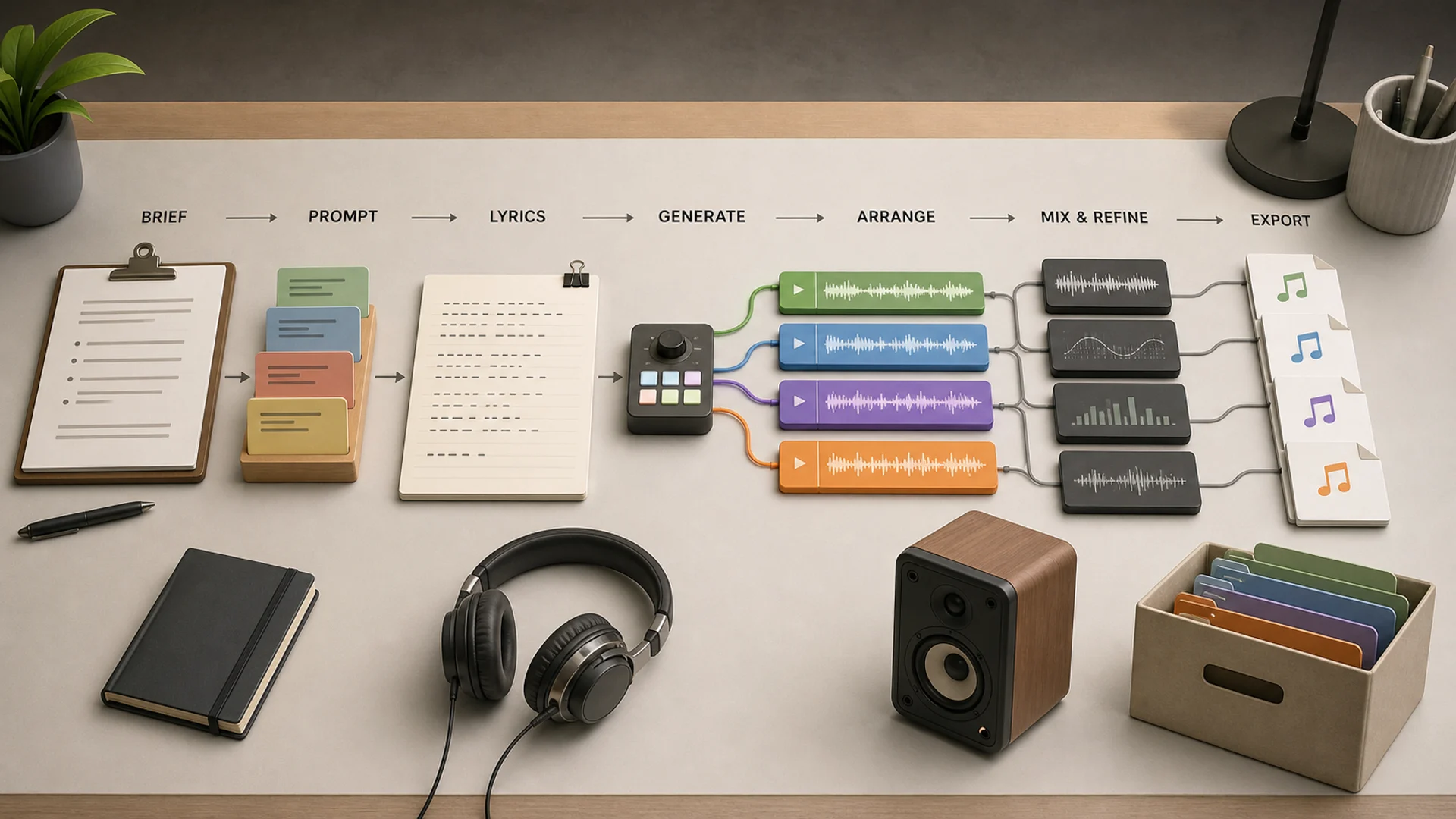 A 2.5D creator workflow showing brief, prompt cards, audio clips, folders, and exports
Rights and commercial-use reality
AI music rights are not a footnote. They are part of the workflow.
Ownership is not the same as copyright eligibility. Suno’s copyright help article says songs made on the Basic/free plan are owned by Suno and are for non-commercial use, while songs made during Pro or Premier subscriptions are owned by the user with a commercial-use license. The same article also warns that material may not be eligible for copyright protection, especially if made entirely with AI.Suno copyright help
Uploads require rights. Suno’s terms require users to have the rights, licenses, consents, permissions, power, and authority needed to submit material and allow Suno to use it in connection with the service.Suno terms Udio similarly says users who upload audio must own the rights to that audio and should not upload commercial music or sounds they do not have rights to use.Udio audio upload AIVA’s legal page says users who upload an influence grant AIVA a license to train its systems on that uploaded influence and warrant that the upload does not infringe third-party rights.AIVA legal
Commercial use is plan-specific. Suno’s pricing page distinguishes free non-commercial use from paid commercial-use rights for new songs made under paid plans.Suno pricing AIVA separates non-commercial, limited commercial, and full-copyright categories.AIVA legal ElevenLabs says Music v2 is trained on licensed data and that generated tracks are cleared for commercial use, while also listing plan-specific exclusions.ElevenLabs Music
Distribution has extra traps. Content ID, DSP ingestion, stock-library uploads, sync licensing, client work, and game/film use may have separate restrictions even when a platform says “commercial use.” Suno’s help article notes that some distributors may reject songs that are not eligible for copyright protection.Suno copyright help Soundraw and AIVA both maintain license pages that should be checked before Content ID, redistribution, or client release.Soundraw license AIVA legal
The operational lesson: every generated track should carry a rights record, not just an audio file.
Best practices by scenario
Short video background music. Start with a short creative brief: mood, pacing, platform, duration target, edit points, and whether the video needs instrumental-only audio. Generate several variants in Suno, Udio, Mureka, AIVA, Soundraw, or a licensed tool. Keep the winning prompt, model, account plan, license snapshot, and export file together. Avoid uploading third-party reference songs unless you have rights.
Campaign jingle. Separate the workflow into lyrics, melody, vocal identity, hook testing, legal review, and final production. Suno and Udio are useful for quick hooks. Seed-Music is relevant conceptually because its published work focuses on controlled music generation, note-level editing, and voice prompts.Seed-Music technical report For client work, use a rights-first tool or require legal review before the final master is used in ads.
Game or app sound. Treat music as interactive assets, not one exported song. Stable Audio, AudioCraft/MusicGen, and open models can help prototype loops, stingers, transitions, and sound design ideas.Stable Audio 3 paper AudioCraft For production, verify license, loop quality, loudness, file formats, and whether stems are needed for adaptive mixing.
Songwriter demos. Use AI music to explore arrangement, genre, vocal delivery, and alternate chorus shapes. Keep original lyrics, chord notes, topline ideas, and generated references separate. If the song may be pitched or released, avoid relying on unclear uploaded references or synthetic vocals that create consent issues.
Enterprise content teams. Build a repeatable approval path: brief, model selection, generation, rights gate, brand review, export, archive, and channel delivery. The bottleneck is usually not generation; it is traceability across people, campaigns, and file versions.
Where MCPlato fits: workflow orchestration, not a native Suno or Udio API
MCPlato should not be described as a replacement for music models, and this article should not imply native Suno, Udio, or Seed-Music API integration. The accurate role is narrower and more useful: MCPlato is a workflow and orchestration layer around browser work, local files, connected materials, scheduled tasks, and artifact production.
MCPlato’s public site describes it as a Desktop AI Engine that can work with local files, browser actions, documents, media, spreadsheets, screenshots, scheduled routines, and parallel conversations.MCPlato homepage Its ClawMode page describes channel-to-workspace workflows where incoming messages land in a workspace, tasks and tools run with context, approvals can be required, and results can return to the original channel.MCPlato ClawMode Its Directory as Conversation article frames a folder as an intelligent workspace with persistent context across files and prior interactions.Directory as Conversation Its Wand page describes repeatable, phased artifact workflows with gates and exportable deliverables.MCPlato Wand
For AI music, that becomes a practical operating loop:
- Brief: Capture audience, channel, duration, mood, references you own, legal constraints, and target deliverables.
- Model selection: Choose a tool by scenario: fast vocal demo, licensed stock-like track, open/local experiment, real-time performance, or stem-heavy edit.
- Prompt and lyrics: Generate prompt variants, lyric drafts, negative prompts, structure labels, and reference notes.
- Batch generation: Use browser-based tools or local models where permitted, then record model, prompt, plan, date, and result.
- Local file management: Store audio, stems, prompts, screenshots of license-relevant plan state, notes, and approvals in the same project folder.
- Stems, edit, and transcode: Use platform stem tools, a DAW, or local audio tools such as FFmpeg where appropriate to create WAV, MP3, loop, preview, or channel-specific exports.
- Rights gate: Verify plan, upload rights, copyright eligibility, Content ID/DSP restrictions, and client-use permissions before publishing.
- Deliverable artifact: Produce a folder, report, cue sheet, audio pack, video edit, or campaign handoff that a teammate can inspect.
- Scheduled monitoring: Use a recurring workflow to check license pages, model updates, campaign performance, or publishing notes, then send a summary back to the team channel.
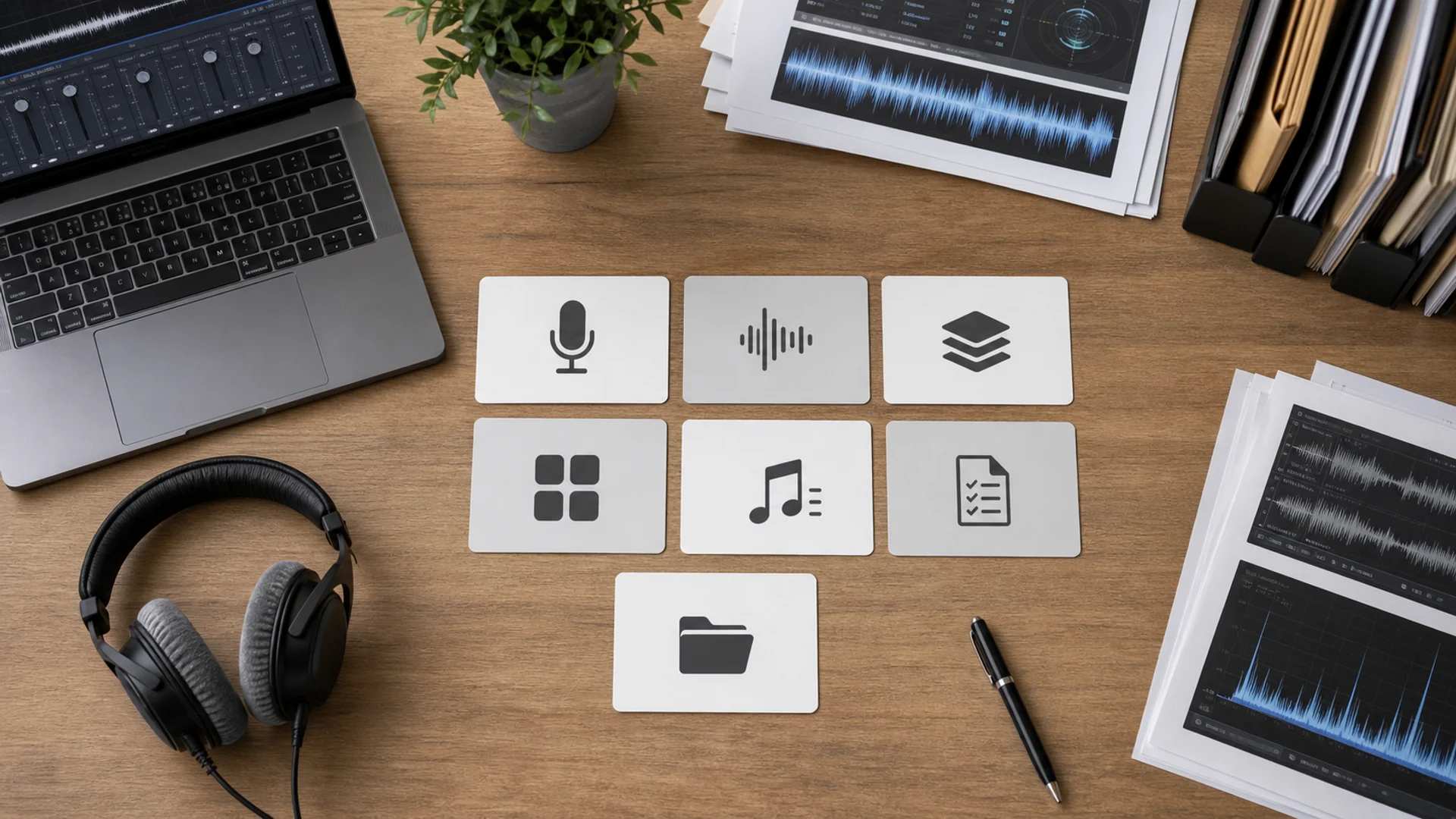 A practical AI music model matrix on a studio desk with abstract cards, audio material, and rights checklist objects
Practical checklist
Before releasing AI-generated music, ask:
- What is the job: demo, social background, ad, game loop, client campaign, or commercial song?
- Which model/tool created the track, under which account plan and terms?
- Did any uploaded audio, lyric, voice, or melody require third-party rights?
- Are commercial use, client work, DSP distribution, Content ID, or stock-library uploads allowed?
- Can the team reproduce the prompt, settings, edit decisions, and final export?
- Are stems, lyrics, prompt history, license notes, and final files stored together?
- Has a human reviewed musical quality, brand fit, legal risk, and final loudness/export format?
If the answer is not documented, the workflow is not production-ready.
FAQ
Is Suno the best AI music generator?
Not universally. Suno is strong for fast song creation, vocals, creator ideation, Studio editing, and stems. But the “best” tool depends on the scenario: Udio for owned-audio iteration, Lyria RealTime for interactive control, Stable Audio or AudioCraft for research/open experimentation, ElevenLabs or AIVA/Soundraw for license-forward workflows, and open projects for local exploration.
Was SeedMusic released today?
I cannot verify that from public official sources. The citable ByteDance Seed-Music page and technical report are from September 2024, and the current Seed models page lists Seed2.1 prominently while including Seed-Music as a GenMedia entry.Seed-Music Seed models
Can AI-generated music be used commercially?
Sometimes, but only under the relevant plan and terms. Suno, AIVA, ElevenLabs, Soundraw, Udio, and open models all require separate review. Commercial use does not automatically solve copyright eligibility, upload rights, Content ID, DSP, or client-work restrictions.
Does MCPlato generate music directly?
MCPlato should be treated as the workflow layer, not as a music model. It helps organize briefs, prompts, browser work, local files, stems, rights checks, exports, scheduled monitoring, and team handoff around specialist music tools.
References
- ByteDance Seed, Seed-Music: https://seed.bytedance.com/en/seed-music
- Seed-Music technical report: https://arxiv.org/abs/2409.09214
- ByteDance Seed models: https://seed.bytedance.com/en/models
- Suno pricing: https://suno.com/pricing
- Suno terms: https://suno.com/terms
- Suno copyright help: https://help.suno.com/en/articles/2746945
- Suno V4.5 feature article: https://help.suno.com/en/articles/5782593
- Suno model timeline: https://help.suno.com/en/articles/5782721
- Suno Studio editing: https://help.suno.com/en/articles/8041473
- Suno Advanced Stem Separation: https://help.suno.com/en/articles/12702337
- Udio changelog: https://help.udio.com/en/articles/10748731-changelog-what-s-new-with-udio
- Udio audio upload: https://help.udio.com/en/articles/10754328-create-music-with-your-own-audio
- Udio credits: https://help.udio.com/en/articles/10739134-credits-and-credit-limits
- Stable Audio 3 announcement: https://stability.ai/news-updates/meet-stable-audio-3-the-model-family-built-for-artistic-experimentation-with-open-weight-models
- Stable Audio 3 paper: https://arxiv.org/abs/2605.17991
- Google Lyria: https://deepmind.google/models/lyria/
- Google Lyria RealTime: https://deepmind.google/models/lyria/lyria-realtime/
- Google generative music tools: https://deepmind.google/blog/new-generative-ai-tools-open-the-doors-of-music-creation/
- Meta AudioCraft: https://ai.meta.com/resources/models-and-libraries/audiocraft/
- AudioCraft GitHub: https://github.com/facebookresearch/audiocraft
- MusicGen paper: https://arxiv.org/abs/2306.05284
- ElevenLabs Music: https://elevenlabs.io/music
- ElevenLabs, Introducing ElevenMusic: https://elevenlabs.io/blog/introducing-elevenmusic
- ACE-Step: https://github.com/ace-step/ACE-Step
- ACE-Step 1.5: https://github.com/ace-step/ACE-Step-1.5
- YuE: https://github.com/multimodal-art-projection/YuE
- DiffRhythm: https://github.com/ASLP-lab/DiffRhythm
- AIVA: https://www.aiva.ai/
- AIVA legal: https://www.aiva.ai/legal/1
- Soundraw license: https://soundraw.io/license
- MCPlato homepage: https://mcplato.com/en/
- MCPlato ClawMode: https://mcplato.com/en/clawmode/
- MCPlato Wand: https://mcplato.com/en/wand/
- MCPlato Directory as Conversation: https://mcplato.com/en/blog/directory-as-conversation/