AI Micro-Dramas Are Here: The End-to-End Workflow from Script to Release
AI micro-dramas are moving from viral experiments to repeatable production systems. This guide maps the script-to-release workflow, compares major video and audio tools, and shows how MCPlato helps creators coordinate the work without pretending AI is one-click filmmaking.
AI Micro-Dramas Are Here: The End-to-End Workflow from Script to Release
AI micro-dramas are no longer a niche format hiding inside short-video feeds. They have become a measurable entertainment market, and generative video is arriving exactly when the format needs faster iteration, more localized variants, and cheaper experimentation.
In China, official data cited by the National Radio and Television Administration reported 662 million micro-drama users by December 2024, a 59.7% internet-user penetration rate. China City News and People’s Daily estimated China’s 2024 micro-drama market at RMB 50.44 billion, up 34.90% year over year and already larger than the RMB 42.5 billion mainland film box office; the same report cited DataEye’s forecast of more than RMB 100 billion by 2027. Sensor Tower reported about $700 million in global short-drama app in-app purchase revenue in Q1 2025, nearly four times Q1 2024, with the U.S. at 49% and leading apps ReelShort and DramaBox at $130 million and $120 million. Omdia, cited by BusinessWire, projected $11 billion in global micro-drama revenue in 2025.
The important conclusion is not that AI has made “one-click filmmaking” mature. It has not. The real shift is practical: the short-drama business model has been validated, and generative tools are lowering the cost of scripts, storyboards, character references, shot candidates, dubbing, music, editing, covers, and release packaging.
For creators and marketers, the question is changing from “Can this model make a beautiful clip?” to “Can we turn an idea into a reviewed, compliant, platform-ready episode?”
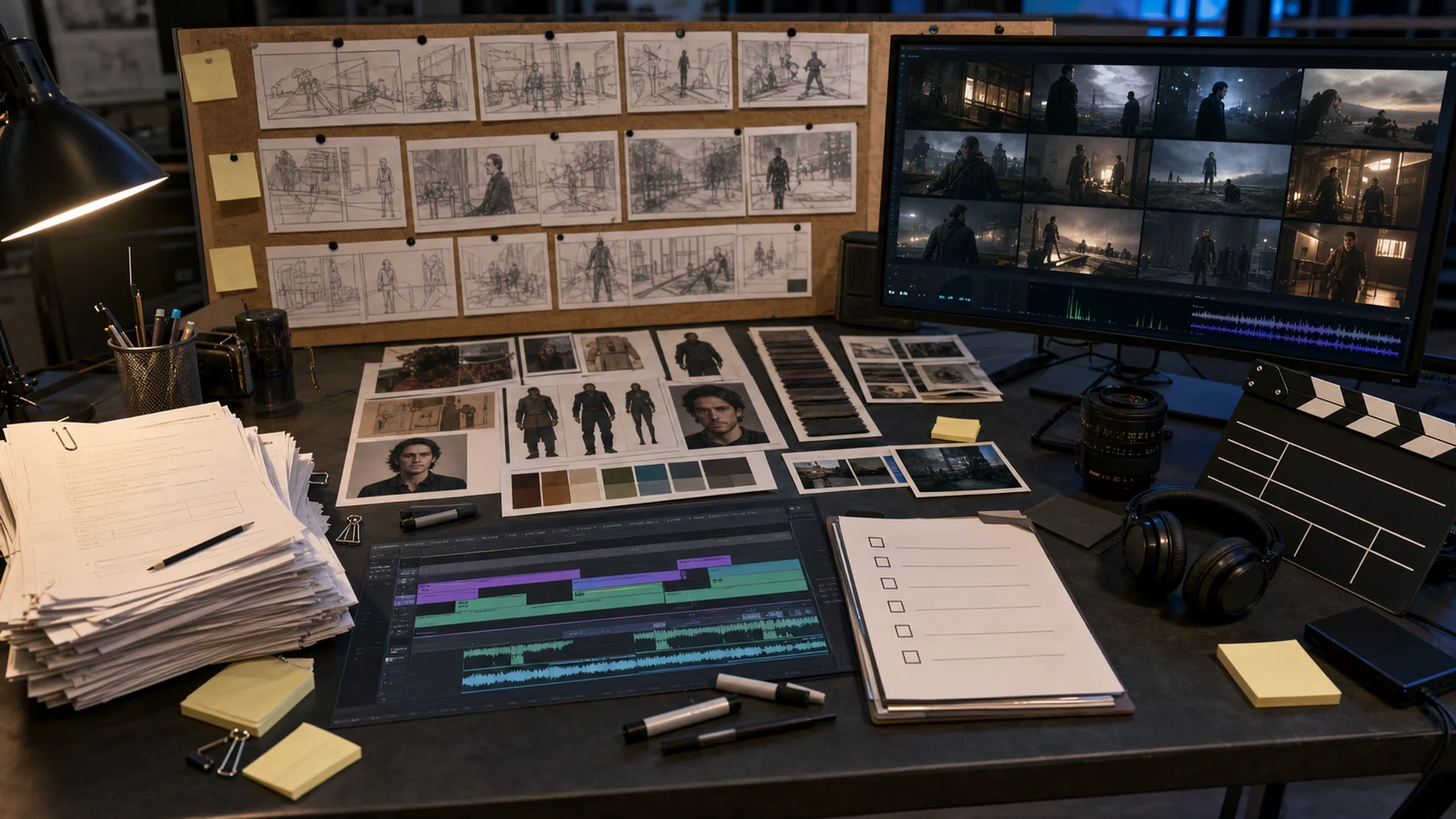 AI micro-drama production pipeline from script to release
Why AI Micro-Dramas Are Rising Now
Micro-dramas fit mobile attention. A story can open with a hook in seconds, escalate in minutes, and monetize through subscriptions, in-app purchases, ads, or lead generation. The format rewards fast testing: alternate openings, posters, localized voiceovers, and rapid iteration around audience response.
AI video tools attack the most expensive parts of that loop. Scripts become cheaper to draft. Storyboards can be generated before production. Character looks can be explored in batches. A five-second reaction shot can be regenerated without booking a location. Voiceover, music, and rough cuts can be tested before final production spend.
Real examples show both the opportunity and the limits. CCTV described Chinese Mythology as China’s first full-process AI micro-drama, with six episodes using AI for art, storyboarding, video, dubbing, and music. People’s Daily Overseas Edition covered Sanxingdui: Future Apocalypse as a 13-episode AIGC sci-fi micro-drama; after its July 2024 Douyin launch, it generated more than 140 million total transmissions and about 135 million Douyin views. Bona Film later described the project as approaching 200 million cumulative transmissions. Securities Times reported that Classic of Mountains and Seas: Splitting Waves used Kling text-to-image and image-to-video workflows, generating five-second shots for manual editing; production took about two months with a dozen-plus people, compared with a traditional estimate of three to six months and roughly 100 people.
Those cases do not prove that AI can replace production judgment. They show that the right workflow can compress iteration cycles and make expensive visual experiments feasible for smaller teams.
The End-to-End Workflow
A reliable AI micro-drama workflow starts before any video model is opened. Treat generation as one stage, not the whole production line.
| Stage | Output | AI assistance | Human review point |
|---|---|---|---|
| Market and concept research | Audience promise, genre, competitors, platform rules | Market summaries, teardown notes, hook analysis | Verify positioning and sources |
| Script development | Season arc, episodes, dialogue, cliffhangers | Draft batches, alternate hooks, localization ideas | Check pacing, compliance, originality |
| Storyboard and shot split | Scene list, shot list, camera intent | Beat-by-beat shots and prompt-ready descriptions | Cut redundant shots |
| Character bible | Face, wardrobe, voice, relationships | Candidate looks and continuity notes | Approve likeness, rights, consistency |
| Video generation | Shot candidates, reactions, transitions | Text-to-video, image-to-video, camera controls | Reject unstable or incoherent clips |
| Voice, music, and sound | Dialogue, narration, effects, BGM | TTS, licensed cloning, sound drafts | Verify rights and tone |
| Editing and packaging | Rough cut, subtitles, thumbnails, versions | Captions, cut suggestions, cover variants | Review continuity and policy |
| Release and learning | Metadata, checklist, performance notes | Feedback summaries and variant tracking | Decide what to repeat or stop |
The workflow is hybrid: AI expands options; humans judge coherence, rights, emotion, and brand fit.
Where the Main Tools Fit
Video generation is now a toolbox, not a single-lane choice. Most teams use different tools for different jobs: Chinese-language ideation, high-end cinematic shots, reference consistency, quick social variants, and separate audio and editing tools downstream.
| Tool or model family | Strong fit in micro-drama production | Watch-outs and best practices |
|---|---|---|
| Kling AI | Text-to-video, image-to-video, sound generation, digital human workflows; useful for dramatic short scenes, image-guided character performance, ads, and short story beats. Kling 3.0 materials emphasize native audio, multi-shot narrative, consistent characters, up to 15-second clips, 1080p, and Pro 4K. | Motion control is stronger for focused subjects than complex multi-person blocking. Use approved character frames. |
| Jimeng AI (ByteDance) | Chinese-language prompting, text or image-to-video, first-and-last-frame control, smart canvas, multi-image fusion, and local repainting; useful for Chinese materials, storyboards, characters, and covers. | Public pricing, duration, and resolution details are less complete. Keep prompts and reference packs organized to reproduce accepted looks. |
| Runway | Gen-3 supports text or image-to-video, Motion Brush, advanced camera controls, and Director Mode; Gen-4 emphasizes consistent characters, locations, and objects from a single reference image. Act-One can drive performances from actor video and voice. | Strong for cinematic control and consistency experiments, but still needs editorial review. Use it where direction, identity, or scene control matters most. |
| Pika | Pika 2.0 Scene Ingredients supports uploaded characters, objects, and scenes; VentureBeat reported more than 11 million users and more than 2 billion platform video views. | Best for social clips, playful ads, teasers, and fast visual exploration. Do not rely on novelty alone for a serialized drama arc. |
| Sora-style systems | Useful as an industry benchmark for storyboard, extend, remix, blend, multiple aspect ratios, and high-quality generation concepts. Earlier public materials discussed up to 1080p, 20-second clips, and multiple formats. | Treat as a benchmark and creative reference, not a guaranteed current production dependency. OpenAI’s Sora page says the product is no longer available as of April 26, 2026. |
| Vidu | Vidu 1.5 highlighted multiple-entity consistency; Vidu 2.0 public messaging emphasized clips in under 10 seconds at $0.0375 per second versus an industry average of $0.084. Useful for reference-to-video workflows and shot candidates. | Use it for candidate generation and consistency tests, then apply the same shot-review checklist as other models. |
| Hailuo / MiniMax | Hailuo Director models such as T2V-01-Director and I2V-01-Director emphasize prompt adherence, preset camera settings, and reduced motion randomness. | Strong fit for cinematic short shots and action with director-style camera control. Keep scenes simple enough for stable motion. |
| Luma Dream Machine | VentureBeat reported the June 2024 launch as generating five-second videos in about two minutes. Useful for concept films, atmosphere, environments, and transitions. | Great for mood boards and transitions; serialized character dialogue still needs careful reference control and editing. |
| ElevenLabs | Large voice catalog, multilingual TTS, voice cloning, and sound effects; useful for dubbing, localization, narration, and temporary voice tracks. | Voice cloning and commercial use require explicit rights. Keep licenses attached to voice assets. |
| Suno and Udio | Useful for background music, theme songs, mood exploration, and temporary tracks. | The RIAA has sued Suno and Udio over copyright issues. Commercial teams should review rights, contracts, and platform policies before release. |
| CapCut and Jianying | AI text-to-video, digital humans, text-to-speech, voice cloning, smart talking-head cuts, AI sound effects, frame interpolation, and enhancement; strong for editing, captions, rough cuts, and social packaging. | Editing automation saves time, but continuity, subtitle quality, rights, and compliance still need human approval. |
The practical pattern is to separate pre-production assets from generated clips. A character bible, shot list, and approved prompt library should survive even if the team changes models. Switching generators should be a production decision, not a full restart.
How MCPlato Fits: A Production Workspace Around the Tools
MCPlato does not replace video models, dubbing tools, music tools, or editors. Its value is coordinating the work around them so ordinary creators and teams can keep the production line visible, repeatable, and reviewable.
A micro-drama team can create a dedicated MCPlato Workspace for one series. The Workspace can hold market data, reference episodes, platform rules, competitor breakdowns, a character bible, prompt templates, shot lists, covers, voice notes, and release checklists. Instead of scattering these across chats, folders, spreadsheets, and browser tabs, the team keeps decisions in one project context.
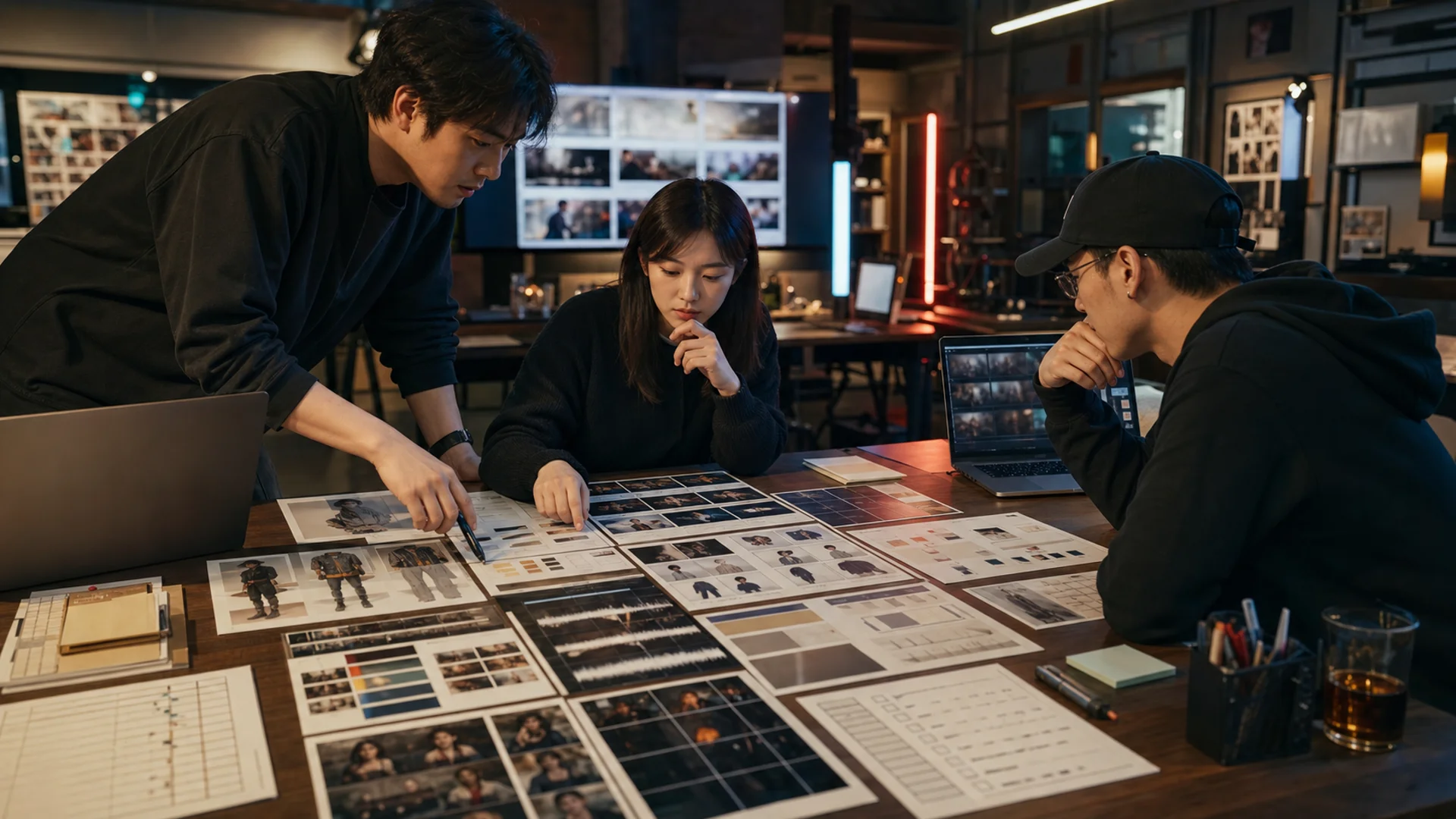 Creator workspace for AI micro-drama character consistency, shot lists, prompts, audio, and review
A practical MCPlato setup might look like this:
- Script batching: draft alternate cold opens, episode outlines, and dialogue variants, then save the approved version for shot splitting.
- Shot decomposition: build shot tables with duration, characters, setting, action, camera intent, prompt, output file, and review status.
- Character consistency: maintain approved face references, wardrobe rules, voice direction, relationships, forbidden changes, and continuity notes.
- Prompt management: keep model-specific templates for image-to-video, camera control, covers, and negative constraints such as no readable brand logos.
- Long-running task tracking: use ClawMode to follow generation batches, organize clips, rename assets, summarize failures, and notify channels when review sets are ready.
- Audio and cover coordination: store voice options, BGM candidates, cover variants, subtitle versions, and platform-specific requirements with episode assets.
- Deliverables: prepare review folders, editing checklists, release notes, and handoff documents.
The key is continuity. A short drama is not only a video file; it is a living set of decisions. MCPlato keeps those decisions connected from the first research note to the final release package.
Efficiency and Cost Advantages
Compared with a traditional short-video or micro-drama workflow, AI-assisted production improves three areas.
First, it reduces iteration cost. Teams can test more hooks, posters, shot angles, and voice tones before committing to final production. A weak opening can be rewritten quickly. A missing reaction shot can be generated or mocked up before scheduling more work.
Second, it reduces dependency on large crews for early visual development. The Classic of Mountains and Seas: Splitting Waves report is a useful benchmark: about two months and a dozen-plus people versus a traditional estimate of three to six months and around 100 people. Not every project will see that ratio, but the direction is clear: AI can compress pre-production and candidate-shot generation.
Third, it makes reusable formats more valuable. Once a team has a proven structure—a hook style, episode rhythm, character bible, cover formula, prompt library, and release checklist—the next episode or localized variant can start from a mature workflow rather than a blank page.
For marketing teams, this matters beyond entertainment. The same workflow can produce product explainers, recruitment stories, educational mini-series, customer-success dramatizations, training stories, and localized campaign teasers. The team must still protect brand safety, rights, and message accuracy.
The Current Limits Are Real
AI micro-drama production is promising precisely because the constraints are visible. The most common failures are not mysterious:
- Character consistency: faces, costumes, age, body shape, and props can drift.
- Narrative continuity: a strong individual shot may not serve the scene.
- Shot stability: hands, objects, camera motion, crowd scenes, and multi-person blocking can still break realism.
- Dialogue and performance: multi-person dialogue, emotional timing, and lip-sync remain hard.
- Rights and copyright: music, voices, likenesses, training-data disputes, and brand references can create legal risk.
- Content review: short dramas may need platform checks, audience-safety review, and formal filing or audit depending on market.
- Commercial licensing: a clip that is fine for testing may not be cleared for paid distribution.
- Cost control: repeated generations can become expensive without a shot plan, acceptance criteria, and stop rules.
Regulation is also becoming more explicit. The NRTA described a classification approach for micro-dramas: key productions at RMB 1 million and above, ordinary productions from RMB 300,000 to RMB 1 million, and other productions below RMB 300,000. It also stated that from June 1, 2024, micro-dramas without review and filing could not be distributed online. AI does not remove those obligations.
Best Practices for a Repeatable AI Micro-Drama Workflow
A mature team should not ask AI to improvise the entire production. It should give each tool a clear job.
- Start with the audience promise: define genre, payoff, episode length, platform, and monetization.
- Write for generation: shorter scenes, clearer actions, fewer simultaneous characters, and concrete visual beats usually generate better shots.
- Approve the character bible early: lock face references, wardrobe, voice, relationships, and forbidden changes before generating dozens of clips.
- Use shot acceptance criteria: define acceptable motion, face consistency, camera stability, and performance before spending more credits.
- Keep prompts model-specific but assets model-agnostic: the script, shot list, and character bible should remain useful if the team switches models.
- Generate in batches, review in batches: compare several shot candidates at once, then regenerate only the specific failures.
- Track rights as metadata: attach source, license, consent, and commercial-use status to voices, music, likenesses, and reference images.
- Use human editorial review: pacing, continuity, cultural sensitivity, and emotional believability still need people.
- Plan compliance before release: review platform rules, local regulations, disclosures, and filing requirements early.
- Save the workflow, not just the final video: the most valuable asset is the repeatable system that produced the episode.
Conclusion
AI micro-dramas are entering a useful phase. The market demand is real, the tools are improving, and early productions show that AI can reduce iteration cost and production time. But the winners will not wait for a perfect one-click movie button. They will build a disciplined workflow: research, script, storyboard, character bible, shot generation, audio, edit, review, compliance, and release.
MCPlato is designed for that workflow. It gives creators and content teams a place to organize materials, coordinate prompts and files, track long-running tasks, and turn scattered AI outputs into reviewable deliverables. In AI micro-drama production, the model creates clips; the workflow creates the series.
References
- National Radio and Television Administration: micro-drama user scale and usage rate
- China City News / People’s Daily: 2024 China micro-drama market scale and 2027 forecast
- Sensor Tower: State of Short Drama Apps 2025
- BusinessWire / Omdia: Microdramas to generate $11 billion in global revenues by 2025
- CCTV: Chinese Mythology AI full-process micro-drama
- People’s Daily Overseas Edition: Sanxingdui: Future Apocalypse AIGC micro-drama
- Bona Film: Sanxingdui: Future Apocalypse project page
- Securities Times: Classic of Mountains and Seas: Splitting Waves production report
- National Radio and Television Administration: micro-drama classification, review, and filing rules
- VentureBeat: Pika 2.0 Scene Ingredients and platform traction
- PRNewswire: ShengShu Technology announces Vidu 2.0
- OpenAI: Sora product availability and official context
- RIAA: copyright litigation against Suno and Udio
- VentureBeat: Luma AI launches Dream Machine
- Runway: Introducing Gen-4
- Runway: Introducing Act-One
- Kling AI: AI video generator
- Kling AI: Image to video
- Kling AI: Text to audio
- Kling AI: AI human
- Videomaker: ByteDance launches Jimeng AI
- MiniMax: Hailuo AI Director model
- ElevenLabs: AI voice generator
- CapCut: CapCut AI features
- CapCut: Text-to-video AI
- MCPlato official website
- MCPlato ClawMode official page