
Why Single AI Tools Fall Short for GEO: A Multi-Agent Workflow Guide
Discover why multi-agent collaboration outperforms single AI tools for Generative Engine Optimization, and how MCPlato streamlines your GEO content workflow
Published on 2026-03-24
Why Single AI Tools Fall Short for GEO: A Multi-Agent Workflow Guide
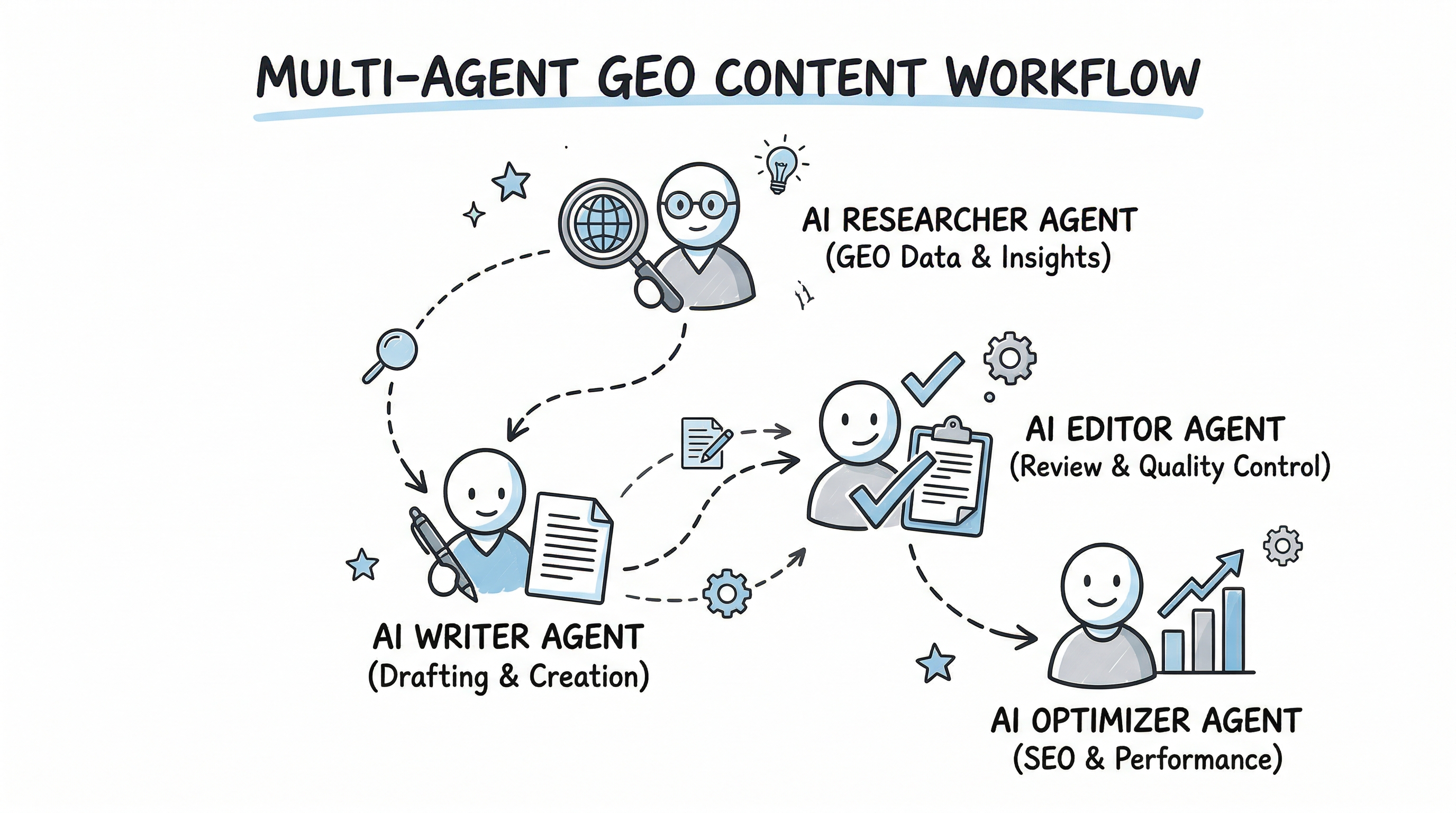 Multi-Agent GEO Content Workflow
Introduction: The GEO Challenge
The content marketing landscape is undergoing its most significant transformation since the birth of search engines. AI Overviews and generative search results are now appearing in 15-30% of Google queries, causing organic click-through rates to plummet by as much as 61% for informational searches.
This shift has given rise to Generative Engine Optimization (GEO)—the practice of optimizing content not for search engine rankings, but for AI understanding, citation, and recommendation.
What is GEO?
Traditional SEO optimizes for rankings—getting your page to position #1 for specific keywords. GEO optimizes for citation—ensuring AI systems reference your content when generating answers.
| Dimension | Traditional SEO | GEO |
|---|---|---|
| Target | Search engine algorithms | AI language models |
| Goal | Rank #1 for keywords | Be cited in AI-generated answers |
| Key Metrics | CTR, bounce rate | Citation frequency |
The Single AI Tool Trap
Why Your Favorite AI Writer Isn't Enough
Most content teams today rely on single AI tools—ChatGPT for drafting, Claude for editing, or specialized platforms like Jasper and Copy.ai. While powerful, these tools share a critical limitation: they were designed for isolated tasks, not integrated workflows.
Let's examine the major players:
| Tool | Strengths | Critical Limitations for GEO |
|---|---|---|
| ChatGPT | Exceptional reasoning, broad knowledge, plugin ecosystem | No document management, no scheduling, limited context persistence |
| Claude | 200K token context, Projects feature, strong brand voice consistency | No native scheduling, limited export options, no multi-agent coordination |
| Jasper | Marketing-focused templates, brand voice enforcement | Template dependency, limited flexibility, single-session workflow |
| Copy.ai | GTM (Go-To-Market) AI platform, structured workflows | Short-form focus, limited long-content capabilities |
| Perplexity | Real-time search with citations, strong research | Not a content creation tool, primarily a search engine |
The Coordination Problem
GEO content creation requires multiple specialized capabilities working in harmony:
- Research Agent: Gathering current data, identifying trends, finding authoritative sources
- Writing Agent: Crafting compelling narratives, maintaining brand voice
- Editor Agent: Fact-checking, style consistency, readability optimization
- SEO/GEO Agent: Structure optimization, schema implementation, entity markup
- Publishing Agent: Formatting, scheduling, distribution
When you use a single AI tool, you're asking one model to context-switch between all these roles—or worse, you're doing the coordination manually, copying and pasting between different tools and sessions.
The Consequence: Subpar GEO Performance
The result? Content that might read well but fails to perform in generative search:
- Outdated information because research and writing happen in isolated sessions
- Inconsistent structure because there's no standardized optimization framework
- Missing schema markup because the writing tool doesn't handle technical SEO
- Poor entity coverage because no single tool ensures comprehensive topic exploration
The Multi-Agent Solution
Why Specialized Agents Outperform Generalists
Research from Microsoft and academic institutions consistently shows that coordinated multi-agent systems outperform single-agent architectures for complex tasks. The reason is simple: specialization allows each agent to develop deeper expertise in its domain, while coordination ensures these expertise areas work together seamlessly.
For GEO content creation, this means:
- Researcher Agents can focus on finding the latest data and authoritative sources
- Writer Agents can concentrate on narrative flow and engagement
- Editor Agents can ensure factual accuracy and brand consistency
- Optimizer Agents can handle technical GEO requirements like schema markup and entity coverage
The MCPlato Advantage
MCPlato was built from the ground up for multi-agent orchestration:
- Multi-Session Orchestration: Run multiple AI sessions simultaneously
- Scheduled Tasks: Automate content updates and monitoring
- MCP Tools: Access web scraping, image generation, data analysis
- Local-First Security: Keep sensitive content on your device
Real-World Workflow: Creating GEO-Optimized Content with MCPlato
Let's walk through a practical example: creating a comprehensive article about "AI Security Best Practices for Financial Services."
Phase 1: Research (Parallel Sessions)
Session 1: Trend Researcher
- Scans recent security breaches, regulatory updates, and industry reports
- Identifies trending keywords and topics in financial AI security
- Gathers statistics on compliance requirements and breach costs
Session 2: Competitor Analyzer
- Reviews top-ranking content on the topic
- Identifies content gaps and opportunities
- Analyzes structure and formatting of high-performing articles
Session 3: Subject Matter Expert
- Deep dives into specific technical areas (encryption, access control, audit logging)
- Gathers authoritative sources and expert quotes
- Validates technical accuracy of concepts
Phase 2: Strategy & Outline (Coordinated Session)
The coordinating session reviews research outputs and:
- Defines the article angle and unique value proposition
- Creates a detailed outline with GEO-optimized structure
- Assigns specific sections to writer agents
- Identifies required schema markup (FAQ, How-To, Article)
Phase 3: Writing (Parallel Sessions)
Multiple writer sessions work simultaneously:
- Introduction Writer: Crafts hook based on latest breach statistics
- Technical Section Writer: Deep dive into implementation details, code examples
- Compliance Writer: Regulatory requirements section, audit preparation checklist
Phase 4: Review & Optimization (Specialized Sessions)
- Technical Editor: Fact-checks all technical claims, validates code examples
- GEO Optimizer: Implements FAQ schema, adds structured data markup
- Style Editor: Brand voice consistency, readability optimization
Total time: 45-60 minutes vs. 4-6 hours with traditional single-tool workflows
Best Practices for GEO Content Creation with MCPlato
1. Define Clear Agent Roles
Don't just create generic "Writer" sessions. Give each session a specific mandate:
- "Compliance Researcher – Focus on GDPR and SOC2 requirements"
- "Technical Writer – Target senior engineers, include code examples"
- "GEO Optimizer – Ensure FAQ schema and entity coverage"
2. Establish Shared Context
Use MCPlato's context sharing to ensure all agents work from the same foundation:
- Shared research documents
- Common style guidelines
- Brand voice examples
- Target audience profiles
3. Implement Human-in-the-Loop
Even with powerful AI agents, human judgment remains essential:
- Review agent outputs before publication
- Verify sensitive claims and statistics
- Ensure brand alignment
- Approve final tone and positioning
4. Schedule Continuous Updates
GEO content requires freshness. Use Scheduled Tasks to:
- Monitor topic trends
- Flag outdated statistics
- Schedule quarterly content reviews
- Track competitor content updates
5. Measure GEO Performance
Go beyond traditional metrics:
- Track AI citation frequency (using tools like Perplexity's source tracking)
- Monitor inclusion in AI-generated answers
- Measure "position zero" appearances
- Analyze entity authority growth
The Future: Agentic AI Content Operations
Gartner predicts that by the end of 2026, 40% of enterprise applications will incorporate task-specific AI agents. For content teams, this means the shift from "AI-assisted writing" to "AI-orchestrated content operations" is already underway.
The organizations that thrive will be those that:
- Embrace specialization over general-purpose AI tools
- Invest in orchestration capabilities that coordinate multiple agents
- Maintain human oversight while automating repetitive tasks
- Measure GEO performance as rigorously as traditional SEO
MCPlato represents this future: a workspace where multiple specialized AI agents collaborate under human direction, producing content that's not just well-written, but optimized for the generative search era.
Conclusion: From Tools to Workflows
The shift from SEO to GEO represents more than a technical change—it is a fundamental rethinking of how content creates value. In a world where AI systems synthesize and present information directly to users, being cited matters more than being ranked.
Single AI tools helped us scale content production. But GEO requires something more sophisticated: coordinated expertise across research, writing, editing, and optimization. This is where multi-agent workflows shine.
MCPlato's architecture—built for parallel session orchestration, scheduled automation, and tool integration—provides the infrastructure for this new approach. The question isn't whether to adopt multi-agent workflows for GEO, but how quickly you can implement them before your competitors do.
The future of content belongs to those who can orchestrate intelligence at scale.
This article was created using MCPlato's multi-session orchestration, with parallel research, writing, and optimization sessions collaborating to produce GEO-optimized content.