
Long-running AI Agent Harness: The Missing Piece for Production-Ready Agents
Why 95% of AI Agent projects fail in production—and how state persistence frameworks like LangGraph, Temporal, and MCPlato are solving the long-running agent problem.
Published on 2026-03-30
Long-running AI Agent Harness: The Missing Piece for Production-Ready Agents
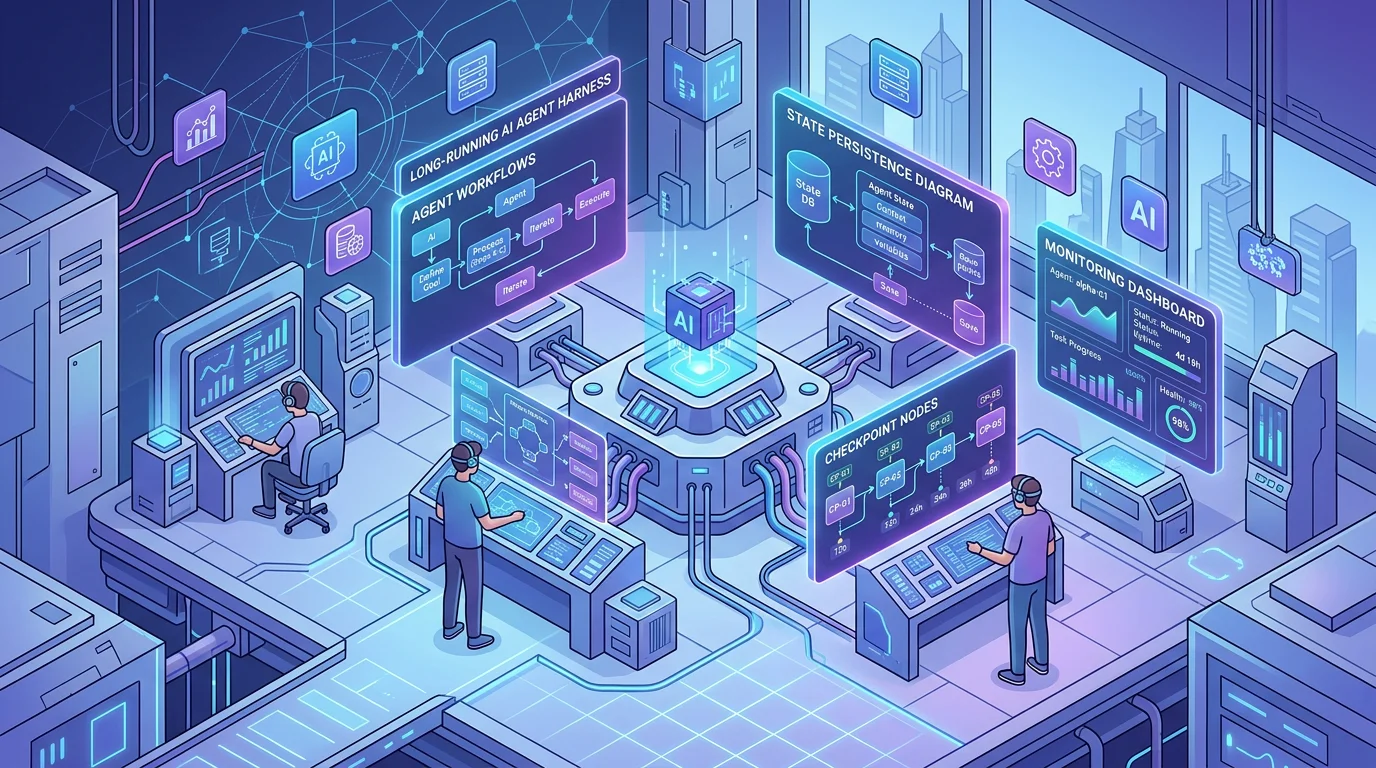 Long-running AI Agent Harness - State Persistence Visualization
Introduction: The 95% Failure Rate
The promise of autonomous AI agents has captivated developers since the release of GPT-4. Yet, despite billions in investment and countless prototypes, 95% of AI Agent projects never make it to production. The reason isn't model capability—it's infrastructure.
Every developer who has built a non-trivial AI agent has faced the same nightmare: the session ends. Whether it's a browser refresh, a server restart, or a simple timeout, the agent loses its entire context. As one Hacker News user painfully observed: "Models have to rebuild the entire world from scratch for every small task."1
This isn't just an inconvenience—it's a fundamental architectural flaw. Real-world agents need to:
- Maintain context across days or weeks
- Resume gracefully after failures
- Handle complex multi-step workflows without losing state
- Coordinate multiple agents without cascading failures
The solution? Long-running AI Agent Harnesses—infrastructure layers designed specifically for persistent, stateful agent execution.
Core Concepts: Understanding the Long-Running Problem
What Is a Long-running AI Agent Harness?
A Long-running AI Agent Harness is an infrastructure layer that sits between your agents and the underlying execution environment, providing:
- State Persistence: Automatic saving and restoration of agent context
- Checkpointing: Granular recovery points within workflows
- Fault Tolerance: Resume from failures without data loss
- Multi-Session Support: Continue work across disconnected interactions
Think of it as the difference between a text editor with auto-save (VS Code) and one without (ed). Most agent frameworks today are running without auto-save.
Anthropic's Initializer Agent + Coding Agent Pattern
In their seminal research on effective agent harnesses, Anthropic introduced a two-phase pattern that has become the gold standard for long-running agents:2
Phase 1: The Initializer Agent
- Analyzes the task requirements
- Sets up the environment and dependencies
- Creates a structured plan
- Initializes the persistent state
Phase 2: The Coding Agent
- Works within the initialized context
- Maintains state across all operations
- Can pause, resume, and recover
- Commits checkpoints at meaningful boundaries
This pattern elegantly separates setup from execution, ensuring that expensive initialization only happens once.
State Persistence vs Checkpoint vs Durable Execution
| Concept | Definition | Granularity | Use Case |
|---|---|---|---|
| State Persistence | Saving agent memory/context | Application-level | Cross-session continuity |
| Checkpoint | Recovery points within a workflow | Step-level | Resume from failure mid-task |
| Durable Execution | Guaranteed completion semantics | Function-level | Mission-critical operations |
Understanding these distinctions is crucial when evaluating frameworks.
Framework Comparison: The State of State Management
| Framework | State Persistence | Ease of Use | Production Ready | Best For |
|---|---|---|---|---|
| LangGraph | Graph-based checkpointing | Medium | ✅ Yes | Complex workflows |
| Temporal | Durable execution | Low | ✅ Yes | Enterprise reliability |
| MCPlato | Native session persistence | High | ✅ Yes | Multi-agent orchestration |
| CrewAI | Limited memory | High | ⚠️ Partial | Rapid prototyping |
LangGraph (~27.9K GitHub Stars)3
LangGraph has emerged as the leading open-source framework for building stateful agent applications. Its graph-based checkpointing automatically persists state at each node transition.
Strengths:
- Built-in persistence layer with multiple backend options (PostgreSQL, SQLite, Redis)
- Thread-based conversation isolation
- Human-in-the-loop support via state breakpoints
- Time-travel debugging capabilities
Trade-offs:
- Steep learning curve for graph-based mental model
- LangChain dependency brings architectural complexity
- Configuration overhead for production deployments
When to use: Complex multi-step workflows requiring detailed observability.
Temporal
Temporal takes a fundamentally different approach with durable execution. Rather than checkpointing agent state, Temporal ensures that every workflow step is executed exactly once, with automatic retry and recovery.
Strengths:
- Battle-tested at Uber-scale production workloads
- Complete event history for replay and debugging
- Language-agnostic (Go, Java, TypeScript, Python)
- Built-in observability and audit trails
Trade-offs:
- Significant infrastructure investment required
- Opinionated programming model requires adaptation
- Overkill for simple agent workflows
When to use: Mission-critical enterprise applications requiring guaranteed execution.
MCPlato
MCPlato takes a workspace-native approach to long-running agents. Rather than bolting persistence onto existing frameworks, MCPlato was designed from the ground up for multi-session agent execution.
Strengths:
- Zero-config session persistence out of the box
- ClawMode autonomous execution across disconnected sessions
- Natural multi-agent orchestration with shared workspace context
- Git-aware state management for coding agents
Trade-offs:
- Smaller ecosystem compared to LangGraph
- Less mature for certain enterprise patterns
- GitHub presence (ranked #2) behind LangGraph
When to use: Teams building collaborative multi-agent systems requiring minimal infrastructure overhead.
CrewAI (~47.5K GitHub Stars)4
CrewAI has the highest star count but the most limited state management. Its memory system uses RAG for short-term context but lacks true persistence.
Strengths:
- Intuitive agent role definition
- Great for quick prototypes
- Active community and documentation
Trade-offs:
- No native cross-session persistence
- Memory doesn't filter by user_id/session_id (known issue)5
- Production deployment requires significant custom work
When to use: Proof-of-concepts and internal tools where state loss is acceptable.
Real User Pain Points
"Rebuilding the Entire World"
The Hacker News comment that "Models have to rebuild the entire world from scratch for every small task"1 captures a universal frustration. Without state persistence, agents must:
- Re-read all source files
- Re-analyze the problem space
- Re-establish context from scratch
- Re-learn user preferences
This isn't just inefficient—it's expensive. Each rebuild consumes tokens, increases latency, and degrades user experience.
The LangChain Abstraction Debate
LangGraph's success hasn't come without criticism. Hacker News threads regularly feature complaints about LangChain's "ridiculous overcomplication of what would otherwise be basic Python" and describe it as a "spaghetti rabbit hole."6
The core tension: abstraction enables powerful patterns (checkpointing, persistence) but at the cost of transparency and debuggability.
Vector DB Memory: The Unreliable Shortcut
Many teams attempt to solve state persistence with Vector DBs—storing conversation history as embeddings and retrieving "relevant" context. This approach has critical flaws:
- Semantic drift: Similarity search may miss critical state
- Token explosion: Retrieved context quickly exceeds limits
- Non-determinism: Same query may return different context
True state persistence requires structured storage, not semantic approximation.
Cascading Failures in Multi-Agent Systems
The most painful production failures occur when Agent A depends on Agent B, which depends on Agent C—and Agent C loses its state mid-execution. Without a harness coordinating persistence, one agent's amnesia becomes everyone's problem.
The MCPlato Differentiation: Honest Assessment
Let's be direct about where MCPlato fits in this landscape.
Where MCPlato Excels
Ease of Use: MCPlato's session persistence requires zero configuration. Create a workspace, and your agents automatically remember everything across sessions. Compare this to Temporal's infrastructure setup or LangGraph's checkpoint configuration.
Multi-Agent Orchestration: MCPlato's workspace model naturally supports multi-agent collaboration. Agents share context through a common filesystem and session history, without explicit state-passing code.
ClawMode Autonomy: The ClawMode feature enables agents to continue working across disconnected sessions—something no other framework offers natively.
Where MCPlato Trails
Enterprise Maturity: For extreme reliability requirements (financial transactions, medical systems), Temporal's durable execution model remains the gold standard. MCPlato doesn't yet offer the same execution guarantees.
Ecosystem Size: With ~27.9K stars, LangGraph has a larger community, more integrations, and faster issue resolution. MCPlato ranks #2 in adoption but trails in absolute numbers.
Framework Flexibility: LangGraph's graph model works with any Python code. MCPlato's workspace model is more opinionated about how agents interact with their environment.
The Honest Ranking
If we rank by GitHub stars and community adoption:
- CrewAI (~47.5K) - Most popular but limited for production
- LangGraph (~27.9K) - Best balance of features and adoption
- MCPlato - Emerging player with unique strengths
- Temporal - Enterprise-focused, smaller open-source footprint
MCPlato's unique value isn't being the biggest—it's being the easiest to use while still production-ready.
Technical Implementation Guide
Checkpoint Strategies
Frequency Trade-offs:
- Too frequent: Performance overhead, storage bloat
- Too sparse: Risk of lost work between checkpoints
- Just right: At natural boundaries (file writes, API calls, user confirmations)
Recommended Approach:
# Pseudo-code for optimal checkpointing
def agent_workflow(task):
    checkpoint("task_start", {"task": task})

    try:
        # Initialization (checkpoint once)
        context = initialize_environment(task)
        checkpoint("initialized", context)

        # Main work (checkpoint at boundaries)
        for step in task.steps:
            result = execute_step(step, context)
            if is_significant_change(result):
                checkpoint(f"step_{step.id}", result)

        # Final state
        checkpoint("completed", final_state)

    except Exception as e:
        # Resume from last checkpoint
        last_state = restore_last_checkpoint()
        retry_with_state(last_state, e)
Best Practices for Production
- Separate ephemeral from persistent state: Not everything needs saving
- Version your state schema: Migration strategies for evolving agents
- Implement health checks: Detect and recover stuck agents
- Monitor checkpoint size: Large states slow recovery
- Test failure scenarios: Simulate crashes, verify recovery
The Market Reality
The Agentic AI Orchestration and Memory Systems market is projected to grow from USD 6.27 billion in 2025 to USD 28.45 billion by 2030, at a CAGR of 35.32%.7
This explosive growth reflects a critical realization: the models are good enough—now we need infrastructure. Companies investing in state persistence today are positioning themselves for the multi-agent systems of tomorrow.
Conclusion: 2026 and Beyond
The era of stateless agents is ending. In 2026, state persistence is becoming table stakes for production AI systems. The question is no longer whether to implement long-running harnesses, but which one fits your needs.
Our recommendations:
- For rapid prototyping: Start with CrewAI, migrate when state matters
- For complex workflows: LangGraph offers the best feature set
- For enterprise reliability: Temporal provides execution guarantees
- For multi-agent collaboration: MCPlato minimizes infrastructure overhead
The "missing piece" isn't missing anymore. The frameworks exist. The patterns are proven. The only question is whether your agents will remember where they left off.
References
This article was produced by the MCPlato Research Team. MCPlato is a long-running AI workspace designed for multi-agent collaboration and stateful execution.
Footnotes
-
Hacker News comment on AI agent state loss, https://news.ycombinator.com/item?id=46515696 ↩ ↩2
-
Anthropic Engineering Blog - "Effective Harnesses for Long-Running Agents", https://www.anthropic.com/engineering/effective-harnesses-for-long-running-agents ↩
-
LangGraph GitHub Repository, https://github.com/langchain-ai/langgraph (27.9K stars as of March 2026) ↩
-
CrewAI GitHub Repository, https://github.com/crewaiinc/crewai (47.5K stars as of March 2026) ↩
-
CrewAI Community Discussion - "CrewAI Memories Multi-Users Environment", https://community.crewai.com/t/crewai-memories-multi-users-environment-conversational-history/4237 ↩
-
Hacker News discussions on LangChain complexity, https://news.ycombinator.com/item?id=36725982 ↩
-
Mordor Intelligence - "Agentic Artificial Intelligence Orchestration and Memory Systems Market", https://www.mordorintelligence.com/industry-reports/agentic-artificial-intelligence-orchestration-and-memory-systems-market ↩