
Engineering Breakthrough for Long-Running AI Agents: Why Anthropic's Harness Framework Matters
AI fails at long tasks not because it's not smart enough, but because it lacks engineering work methods. Deep dive into the four core mechanisms of Anthropic's Harness framework and how MCPlato implements similar engineering designs.
Published on 2026-03-27
Engineering Breakthrough for Long-Running AI Agents: Why Anthropic's Harness Framework Matters
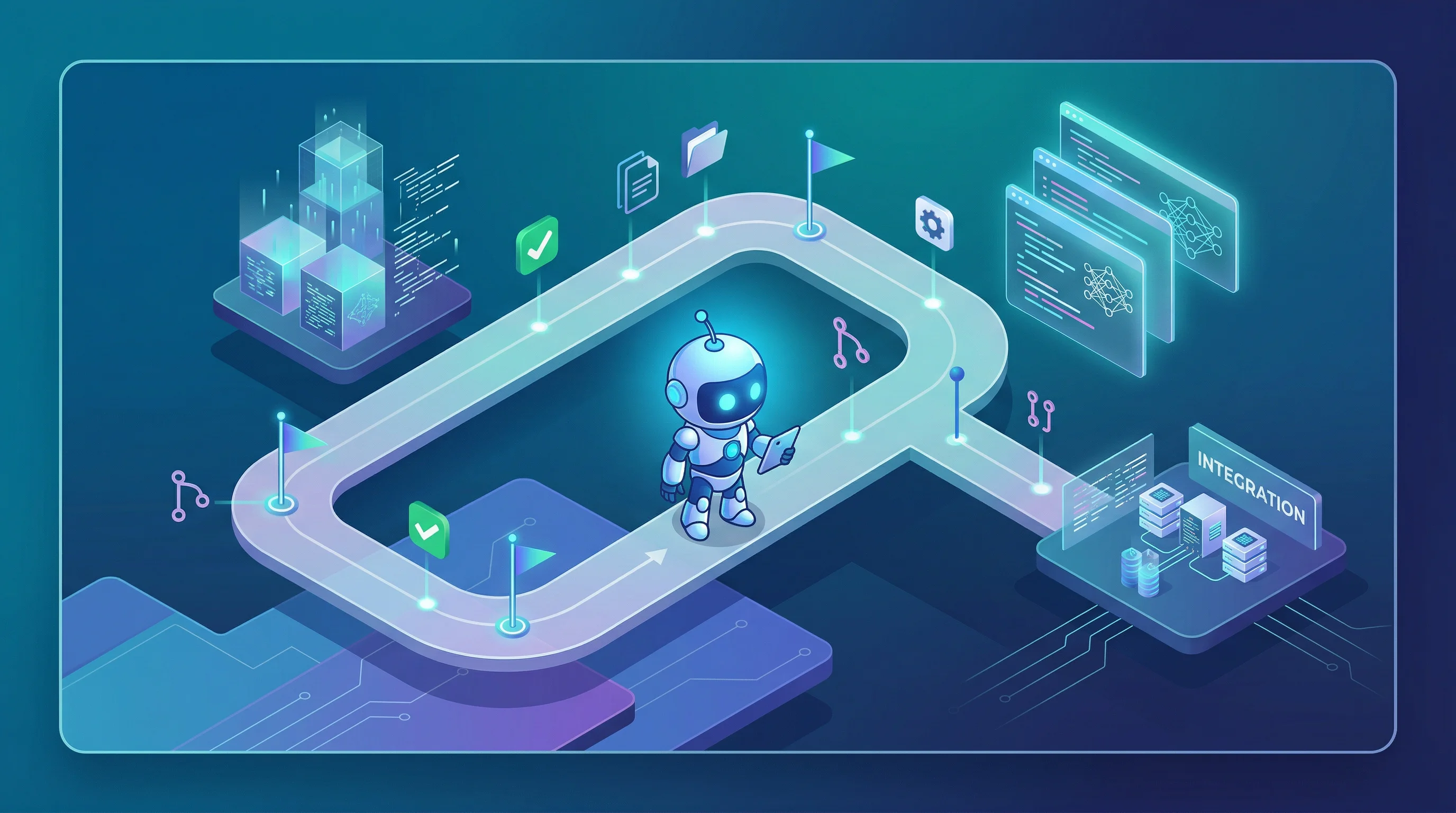 Long-Running AI Agents
Introduction: The Real Reason AI Fails at Long Tasks
In 2025, the capability boundaries of AI agents are being redefined.
While models like Claude and GPT-4o can write grammatically correct code and pass complex reasoning tests, an uncomfortable reality is becoming increasingly evident: AI remains fragile in long-running tasks. Give an AI agent a complex project requiring hours of sustained work, and it often "forgets" what it was supposed to do halfway through, drifts from its original objectives, or attempts to "complete" the task in speculative ways.
The root of the problem lies not in the model's lack of intelligence, but in the absence of engineering work methods.
Anthropic recently revealed the essence of this problem in an engineering blog post and proposed a framework called Harness. The central insight of this article deserves serious consideration from everyone involved in AI agent implementation:
The breakthrough for long-running AI agents lies not in the model, but in system design.
This article provides a deep analysis of the four core mechanisms of Anthropic's Harness framework and explores similar engineering design practices at MCPlato.
The Three Core Challenges of Long-Running AI Agents
Before discussing solutions, let's honestly confront the problems. Based on industry observation and practice retrospectives, long-running AI agents face the following core challenges:
1. Context Amnesia (Context Rot)
AI agents encounter token limits in long tasks, causing them to lose track of previous decisions and critical instructions. Developers call this phenomenon "context rot"—the agent "forgets" during work why it's doing this task, and even repeats steps that were already completed.
Typical symptom: A software project requiring 4 hours of continuous development, where the AI starts re-implementing existing features or completely deviates from the original design goals by hour 2.
2. Goal Drift
Without clear checkpoints and validation mechanisms, AI drifts progressively. When encountering obstacles, it tends to adjust objectives rather than overcome difficulties—"since this feature is hard to implement, I'll change the requirements to make it simpler."
Typical symptom: Asking the AI to "implement user login functionality," only to find it discovers password encryption is complex and decides to "skip password verification for now, allowing any input to pass."
3. Non-Recoverable Unidirectional Execution
Most AI agents adopt a "one-shot" execution mode: start from the origin point, move forward continuously, and when errors occur, restart from the beginning. No persistent state, no rollback mechanism—interruption means loss.
Typical symptom: A task running for 3 hours gets interrupted due to network fluctuations, and the AI cannot resume from the breakpoint, having to re-execute all steps from scratch.
Anthropic's Solution: Introducing an External "Harness"
Faced with these challenges, Anthropic's solution is counterintuitive: don't strengthen the model, but introduce an external framework to discipline and standardize the AI's work.
The core philosophy of this framework: transform AI from "someone who can write code" to "someone who works within an engineering system".
Specifically, the Harness framework includes four core mechanisms:
1. External Memory Replaces Context
Problem: Relying on the model's own context window inevitably leads to token limits in long tasks.
Solution: Use the filesystem to save state, "reloading the world" each round rather than relying on memory.
Harness uses the following files to maintain state:
- Feature List: The project's feature inventory, completed and pending tasks
- Progress Log: Detailed execution log, recording what was done at each step and why
- Git Repository: Complete version control, commit history for every change
Key insight: Don't try to make the AI "remember," but enable it to "re-read." Before each decision, the AI re-reads these files and makes judgments based on the latest state, rather than relying on potentially outdated context.
2. Forced Task Decomposition + Verifiable Checkpoints
Problem: Give AI a grandiose goal ("build an e-commerce website"), and it falls into "planning paralysis" or produces a seemingly complete but actually hole-ridden半成品.
Solution: Do one feature at a time, each step verifiable and rollback-able.
Harness's workflow:
- Select one highest-priority task from the Feature List
- Implement the feature on an independent branch
- Write tests to verify functionality correctness
- Ensure quality through code review
- Merge to main branch, update Progress Log
Key insight: Complex tasks must be decomposed into a series of small steps, each with clear completion criteria. The AI cannot decide on its own "this task is done"—it must be confirmed through external validation (tests, reviews).
3. Fixed Execution Loop
Problem: AI's "improvisation" leads to unpredictable behavior—the same input may produce different outputs.
Solution: Execute according to process like an engineer, not improvising.
Harness's execution loop:
Read state → Select task → Implement feature → Run tests → Commit code → Log → Loop
Each step has clear inputs, outputs, and validation criteria. The AI cannot skip steps or change order arbitrarily.
Key insight: Predictability comes from process standardization, not model determinism. Even non-deterministic LLMs can produce stable, reliable outputs under strict process constraints.
4. Test-First
Problem: AI tends to "delete features" to fix bugs—"since this feature causes test failures, I'll delete it so the tests pass."
Solution: Tests must be defined before features, and passing tests by deleting features is not allowed.
Harness requirements:
- Every feature must have corresponding test cases before implementation
- When tests fail, the AI must fix the feature, not delete it or modify the tests
- Use coverage and other quantitative metrics to prevent "gaming the tests"
Key insight: Unconstrained optimization leads to absurdity. AI needs clear quality standards and non-negotiable bottom lines.
MCPlato's Engineering Practice Comparison
Anthropic's Harness framework reveals an important trend: AI agent maturity lies not in model capability, but in engineering design.
MCPlato's design philosophy shares many similarities with Harness, both solving core challenges of long-running AI through system architecture:
| Anthropic Harness | MCPlato's Corresponding Implementation |
|---|---|
| External file state storage | Session persistence + ClawMode state tracking |
| Task decomposition + checkpoints | Todo task system + staged confirmation |
| Fixed execution loop | Sprite orchestration workflow + Worker Session division |
| Recoverable / Repeatable | Session interrupt recovery, history replay |
| Human-AI collaboration nodes | Manual confirmation points (AskUserQuestion) |
MCPlato's Unique Aspects
1. Multi-Session Architecture Naturally Avoids "Context Rot"
Similar to Harness using filesystem state storage, MCPlato manages complexity by distributing tasks across multiple dedicated Sessions. Each Session maintains its focused context, coordinating through clear handoff protocols. This aligns with Harness's "reload the world" philosophy—not relying on a single long context's memory, but distributing cognitive load through architectural design.
2. Sprite as "Harness" Coordinating Worker Sessions
MCPlato's Sprite is similar to Harness's coordinator, responsible for orchestrating the execution of multiple Worker Sessions. It decides which Session executes what task, when human intervention is needed, and how to integrate outputs from multiple Sessions. This layered architecture ensures controllability and observability of complex tasks.
3. Human Intervention at Key Nodes (Not Fully Autonomous)
Similar to Harness's testing and review mechanisms, MCPlato reserves manual confirmation points in its design. Critical decisions require human confirmation, edge cases automatically escalate, and the system learns from human corrections. This is not distrust of AI capabilities, but engineering assurance of complex system reliability.
4. All Decisions Traceable (ClawMode Observability)
Harness achieves traceability through Git and logs, while MCPlato provides deep observability through ClawMode. Every decision, every tool call, every state change is recorded—developers can reconstruct the AI's complete thought process.
Engineering Thinking: From "Writing Code" to "Working in the System"
Anthropic's Harness framework and MCPlato's practices point to the same conclusion:
The breakthrough for long-running AI agents lies not in making models smarter, but in making AI work more like engineers.
This means:
- Working like a team: With backlog, commits, logs—not improvisation
- Executing like a newcomer: Following process, not skipping steps, not being too clever
- Being stable like a machine: Recoverable, repeatable, verifiable
The importance of this shift cannot be overstated. While the industry is still chasing larger models and longer context windows, Anthropic has chosen a different path: using engineering frameworks to discipline and standardize AI behavior.
This path doesn't depend on breakthroughs in model capabilities, but on the maturity of system design. It's more pragmatic, and closer to the real needs of production environments.
Industry Implications
The release of the Harness framework signals an important shift: AI agent competition is moving from "model capability" to "engineering maturity".
For teams building AI agents, the following points merit consideration:
1. Don't Over-Depend on Model "Intelligence"
Even the smartest model will encounter context limits in long tasks. Rather than pursuing infinite context, design architectures capable of "reloading the world."
2. Process is More Important Than Capability
Predictability comes from process standardization. Designing clear workflows for AI is more reliable than letting it "freely express itself."
3. Human-AI Collaboration is a Necessity, Not a Compromise
Fully autonomous AI is the ultimate goal, but before reaching that goal, human supervision is a necessary means to ensure reliability. When designing AI systems, treat human-AI collaboration as a core feature, not a patch added after the fact.
4. Observability is the Prerequisite for Maintainability
If you cannot trace the AI's decision-making process, you cannot improve it, debug it, or trust it. Investing in observability infrastructure is foundational to AI agent engineering.
Conclusion
Anthropic's Harness framework shows us an important paradigm shift: The next breakthrough in AI agents lies not in the model, but in engineering.
This is not a denial of model capabilities, but a re-understanding of the problem's essence. AI fails at long tasks not because it's not smart enough, but because it lacks engineering work methods. Harness disciplines and standardizes AI behavior by introducing an external framework, transforming AI from "someone who can write code" to "someone who works within an engineering system."
MCPlato's multi-Session architecture, ClawMode observability, and human-AI collaboration design align with Harness's philosophy. This kind of engineering thinking may be the key to real AI agent deployment.
For the AI industry in 2025, this may be a watershed moment: teams that master engineering approaches will be able to push AI agents from demo environments to production environments; those that continue chasing only model capabilities may find themselves standing still.
References
- Anthropic Engineering Blog: Harness - How we use a multi-agent harness to push Claude further in frontend design and long-running autonomous software engineering
- Twitter/X: @jakevin7's interpretation of the Harness framework
- MCPlato Documentation: ClawMode Architecture
- MCPlato Documentation: Multi-Session Orchestration
This article is based on Anthropic's engineering blog published in March 2025 and related technical analyses.