
Codex Can Build the Market Tool. MCPlato Can Run the Research Desk.
A practical Codex vs MCPlato guide for prediction-market research workflows, recurring briefs, decision logs, and Wands.
Prediction-market research looks simple from the outside: find a market, read a price, compare it with your view. In practice, the work is messier. A weather market may depend on an official forecast update. A macro market may move around a scheduled release. A sports or policy market may react to a source that arrived while you were away from the desk. Your local model may disagree with the market, but the disagreement is only useful if you know which data version, source timestamp, and assumptions produced it.
That is why the interesting question is not “Can AI predict markets?” It should not be. Prediction-market prices are market-implied probabilities, not certainty. A price can be a useful signal of crowd expectations, but it is not a fact about the future, and it is not a recommendation.
The better question is operational: who keeps the research loop running?
Codex is a natural answer when the job is to build the machinery: API connectors, parsers, notebooks, tests, dashboards, data-cleaning scripts, and pull-request review. MCPlato is a natural answer when the job is to operate the research desk around that machinery: scheduled briefs, local workspace context, ClawMode delivery, permissioned review, decision logs, and Wands. MCPlato is not a trading bot and does not give investment advice. The useful pattern is research productivity, not automated trade execution.
The missing layer is the research desk
A serious prediction-market workflow is a loop:
- Monitor selected markets and external sources.
- Translate price movement into market-implied probability.
- Compare that probability with source changes, local models, and prior assumptions.
- Send a short brief or alert with links and timestamps.
- Ask the human what to review, record, or ignore.
- Preserve the decision trail.
- Review outcomes and improve the workflow.
Codex can help engineer many parts of that loop. It can work in a repository, run commands, maintain code, review PRs, and automate recurring project work. Public Codex docs also describe data/report work, browser and computer-use surfaces, and automations, so the fair comparison is not “Codex cannot do scheduled tasks” or “Codex only writes code.”
The difference is product shape. Codex is strongest when the center of gravity is a codebase. MCPlato is shaped as a Desktop AI Engine and AI coworker inside a local-first workspace: files, browser, documents, scheduled tasks, ClawMode channels, permissions, Skills/Distill, and Wands. If Codex is where the workflow gets engineered, MCPlato is where the workflow keeps running.
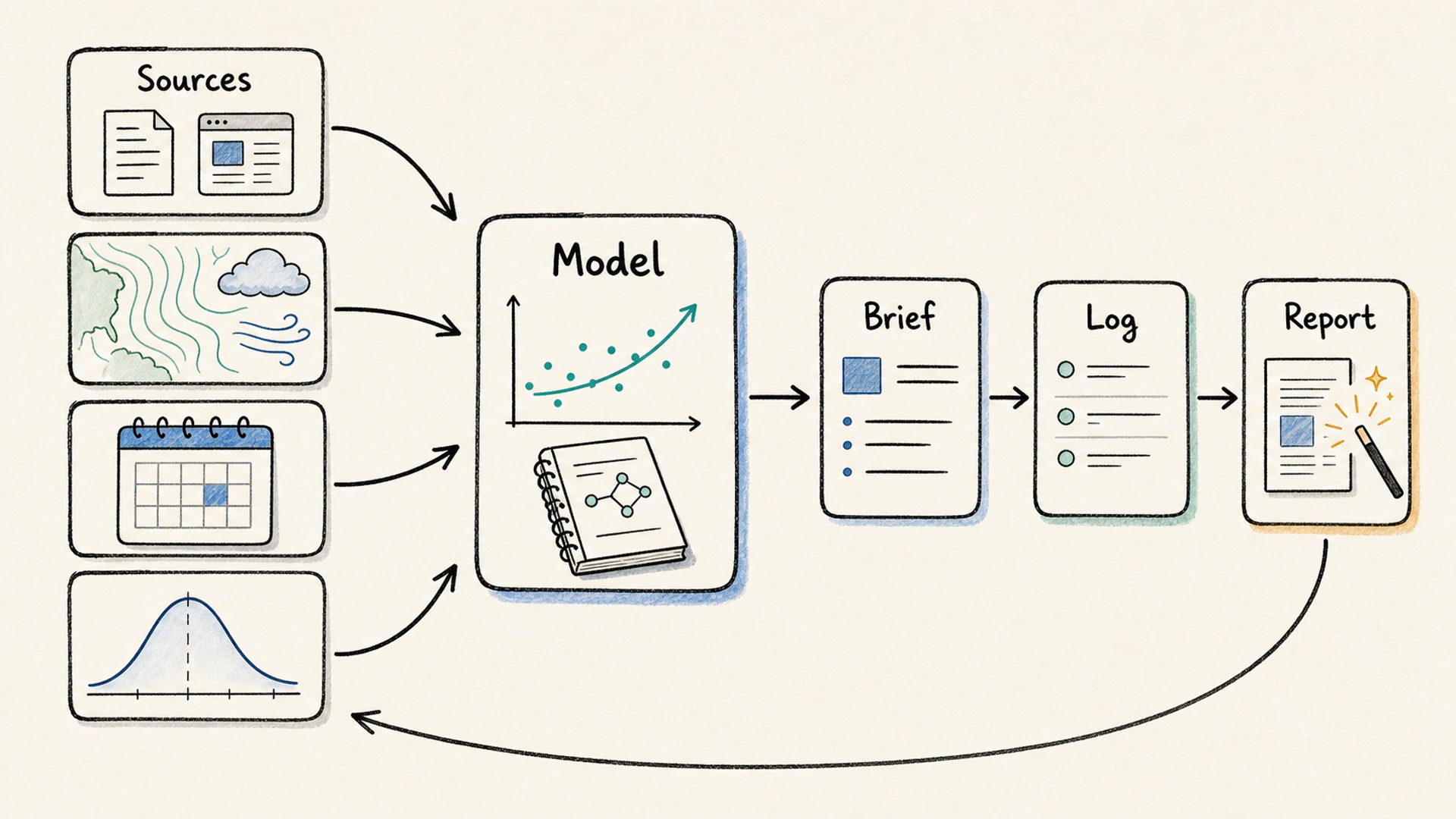 Hand-drawn workflow from public sources and market snapshots into a scheduled MCPlato brief, decision log, and Wand artifact.
Figure: A prediction-market research loop is not one prompt. It is source monitoring, model review, human decision capture, and reusable artifacts.
Codex vs MCPlato for prediction-market research
| Workflow need | Where Codex fits better | Where MCPlato fits better | How to use together |
|---|---|---|---|
| Market, weather, or macro connectors | Build API clients, normalize data, write tests, document setup, review PRs. | Run the connector on a schedule and combine outputs with local notes. | Codex builds the connector; MCPlato runs the daily brief. |
| Local models and notebooks | Refactor model code, add smoke tests, improve reproducibility, generate charts. | Execute the recurring model review, capture timestamps, and save notes locally. | Codex maintains the model; MCPlato compares output with market-implied probability. |
| Alerts | Implement thresholds, polling, WebSocket clients, and reliability checks. | Deliver contextual alerts through IM and ask what the human wants to do next. | Codex builds the monitor; MCPlato turns alerts into review choices. |
| Decision records | Create templates, scoring scripts, or analysis utilities. | Append source-linked decision logs and keep a local research trail. | Codex improves the log tooling; MCPlato keeps the habit alive. |
| Reports and artifacts | Generate helper scripts, charts, and data exports. | Turn repeated work into staged Wands with review gates and exports. | Codex improves components; MCPlato operates the artifact lifecycle. |
| Permissions and review | Use sandbox and approval policies around development work. | Ask before sensitive workspace changes and keep the user in the loop through channels. | Both require human review; neither should be framed as an auto-trader. |
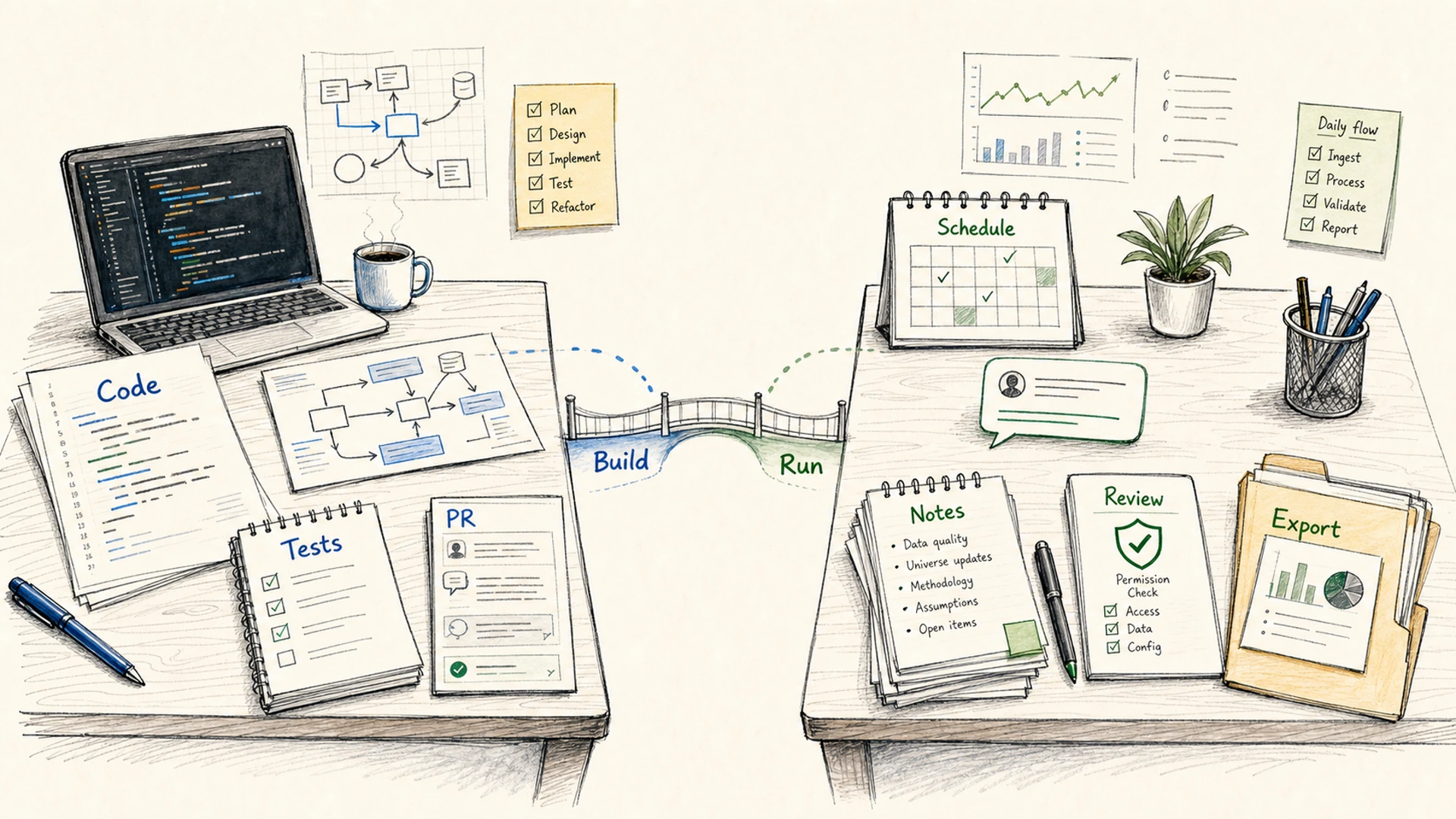 Balanced two-workbench comparison: Codex with connector code, tests, and PR review; MCPlato with schedules, local notes, IM delivery, permissions, and Wands.
Figure: The strongest workflow is not adversarial. Codex builds and maintains the engineering layer; MCPlato operates the recurring research layer.
Scenario 1: daily weather-to-market brief
Weather-sensitive markets are a good example because the source cycle is external. Forecasts, active alerts, observations, and grid data can change before the user opens a dashboard. The research job is not to make a financial decision. It is to ask: what changed since yesterday, which watched markets may be affected, and what assumptions should be reviewed?
Codex can build a National Weather Service connector, parse the response, and test edge cases. MCPlato can run the morning check, compare the update with yesterday’s saved brief, send a concise ClawMode message, and store the note in the local workspace.
Every weekday at 7:00 AM, prepare a weather-to-market research brief for the markets in ./watchlists/weather-markets.csv.

Use public weather sources first, including NWS forecasts and active alerts when available. Compare the latest source changes with yesterday's brief in ./research/weather-briefs/.

Output:
1. Markets to watch today
2. What changed since yesterday
3. Source links and timestamps
4. Assumptions that became stronger or weaker
5. Questions I should review manually

Send the summary to my Feishu channel and save a markdown copy locally.
Do not provide investment advice, recommend trades, or execute/place/cancel orders.
Scenario 2: local model run and review
Many quant-minded users already have a notebook or script. The weak point is not always the model; it is the operating discipline around the model. When did it run? Which input file did it use? Which market price was compared? Was the market-implied probability different because the model was stale, the market moved, or an assumption changed?
Codex is a strong fit for improving the model repo. MCPlato is a strong fit for running the recurring review and producing a source-linked note.
Run the model notebook in ./models/event-probability/ and compare the output with the latest market-implied probabilities for the markets listed in ./watchlists/core-events.csv.

Create a review note with:
- model probability
- market-implied probability
- difference
- input data timestamp
- model version or git commit
- likely reason for any large gap
- whether the gap is caused by stale data, model assumptions, or market movement

Save the note to ./research/model-reviews/ and ask me before changing any workflow files.
Do not provide investment advice, recommend trades, or execute/place/cancel orders.
Scenario 3: alert-to-decision log
An alert that says “probability moved” is often not enough. A useful alert explains what changed, which source or market snapshot changed, which assumptions are affected, and what the human can do next. The options should be research actions: record a decision, schedule a recheck, or ignore the alert.
This is where MCPlato’s personal workspace operating layer matters. ClawMode can deliver the alert where the user already works, while the local workspace keeps the decision log and source context.
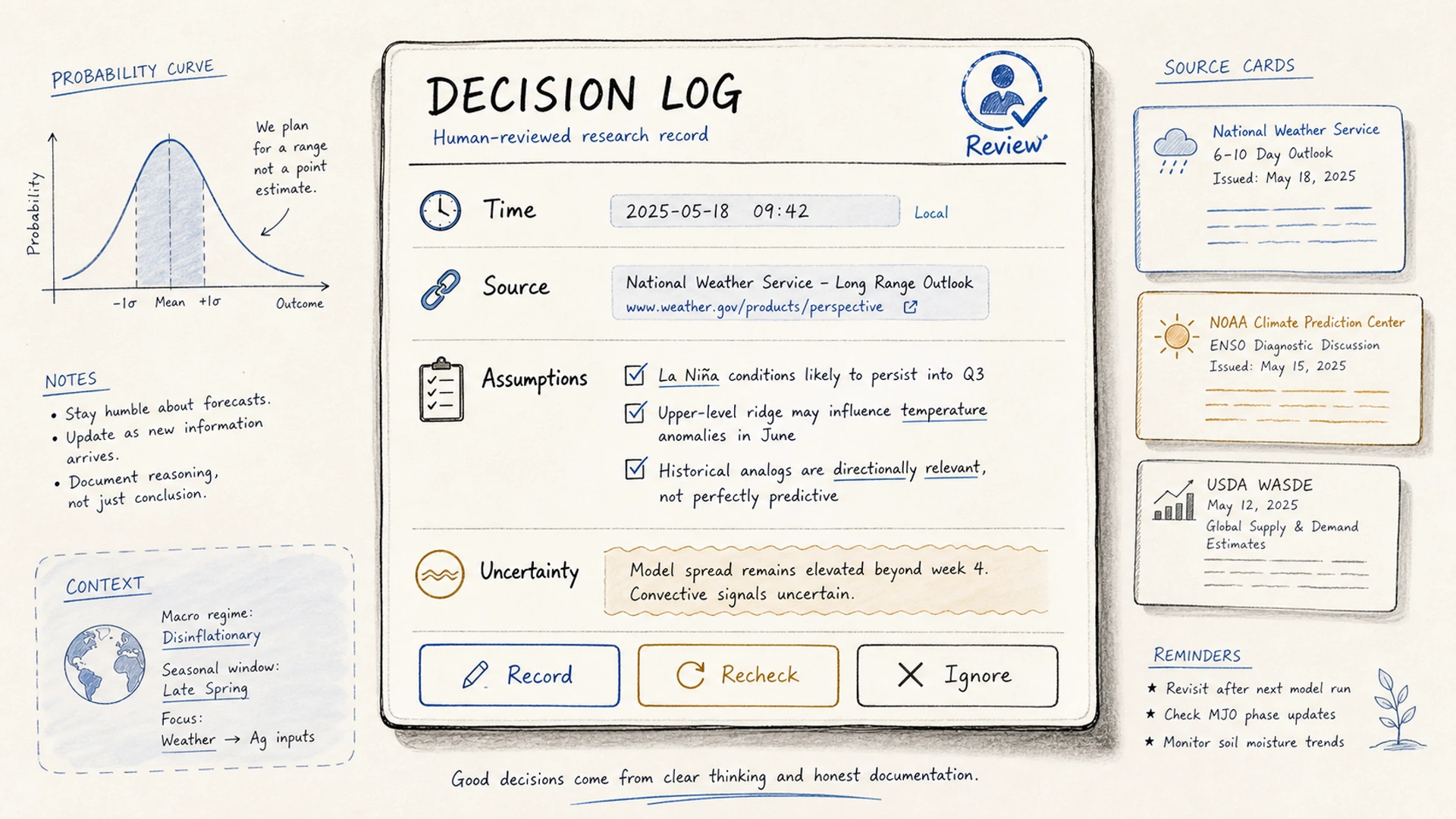 Hand-drawn decision-log card with timestamp, source link, affected assumptions, uncertainty note, and human review choices.
Figure: A market alert becomes useful when it includes context, uncertainty, and a human-reviewed decision trail.
Monitor the markets in ./watchlists/alerts.csv during my working hours. If a market-implied probability moves by more than 8 percentage points, or if an official source updates, send me an alert.

For each alert, include:
1. What changed
2. Which source changed
3. The affected assumptions
4. A short uncertainty note
5. Three options: Record decision, Schedule recheck, Ignore

If I choose Record decision, append my note and the source snapshot to ./research/decision-log.md.
Do not provide investment advice, recommend trades, or execute/place/cancel orders.
Scenario 4: research-to-Wand artifact
A repeated research process eventually becomes too important to leave as scattered chats, CSVs, dashboards, and notebook outputs. It needs stages, review gates, and exports. That is the Wand use case: turn a recurring workflow into a visible artifact that can be inspected, steered, approved, resumed, and exported.
Codex can keep the scripts healthy. MCPlato can coordinate the artifact lifecycle.
Create a Wand for my weekly prediction-market research review.

The Wand should have stages:
1. Align markets and scope
2. Collect market data and external sources
3. Run my local model
4. Generate charts and a written brief
5. Check every factual claim has a source
6. Export a PDF and update the decision log

Start by asking me for the watchlist file and the output folder. Keep the artifact reviewable at every stage.
Do not provide investment advice, recommend trades, or execute/place/cancel orders.
Scenario 5: macro release monitor
Macro markets depend on scheduled releases, revisions, and official updates. A useful monitor does not need to invent a forecast. It needs to know what release changed, what prior snapshot it should compare against, and which watched events may deserve manual review.
FRED-style release and series data makes this concrete. Codex can build the ingestion and validation code. MCPlato can run the scheduled monitor, update local artifacts, and notify the user.
Set up a recurring macro-event monitor for the FRED releases and market watchlist in ./watchlists/macro-events.csv.

On each run:
- check upcoming and newly updated economic releases
- identify which watched markets may be affected
- compare the new data with the previous saved snapshot
- update ./research/macro-dashboard.wand if needed
- send a concise briefing to Slack

Ask me before changing the watchlist, model assumptions, or Wand structure.
Do not provide investment advice, recommend trades, or execute/place/cancel orders.
Scenario 6: weekly postmortem
The most valuable part of a research workflow may happen after the event. A postmortem can ask: which alerts were useful, which were noise, which assumptions changed, where did the local model diverge from market-implied probability, and what should be improved next week?
This does not promise better returns or better accuracy. It creates a reviewable research habit. Brier-style probability review and decision journals are useful because they keep attention on calibration, assumptions, and hindsight bias rather than simple “right or wrong” stories.
Every Friday afternoon, create a postmortem from this week's market briefs, alerts, model reviews, and decision log.

Summarize:
1. Which assumptions changed
2. Which alerts were useful or noisy
3. Where my model disagreed with market-implied probabilities
4. What I learned after outcomes or new sources arrived
5. What to change in next week's watchlist, model, prompt, or Wand

Save the report locally and ask me before making any workflow changes.
Do not provide investment advice, recommend trades, or execute/place/cancel orders.
The handoff that makes both tools stronger
The practical workflow is simple:
- Use Codex to build or repair the connector, notebook, parser, dashboard, or test suite.
- Put the reliable tool in a local project folder with a clear README and smoke test.
- Ask MCPlato to run the workflow on a schedule, combine it with local notes, send a brief, and preserve the research trail.
- When the workflow breaks, ask MCPlato to summarize the failure and prepare a precise issue for Codex.
- Keep the human as the decision-maker.
I used Codex to build the connector in ./tools/market-monitor. Review the README, run the smallest smoke test, and then schedule it as a daily MCPlato briefing.

If tests fail, summarize the failure and prepare a clear issue for Codex to fix. If tests pass, create a scheduled task that runs the connector, updates ./research/latest-brief.md, and sends the result to my IM channel.

Ask me before editing the connector, changing credentials, or modifying the scheduled task.
Do not provide investment advice, recommend trades, or execute/place/cancel orders.
This is the point of the Codex vs MCPlato comparison. Codex is excellent when the output should be code, a diff, a test, a PR, or a maintained repository. MCPlato is compelling when the output should be a recurring, human-reviewed workspace routine: a morning brief, an alert with context, a model review note, a decision log, a Wand, or a weekly postmortem.
For prediction-market-style work, that distinction matters. The market price is not certainty. The AI assistant is not a financial advisor. The goal is not to automate judgment away. The goal is to make the research process more repeatable, source-linked, and reviewable—so the human can make better-documented decisions without pretending the system knows the future.
References
- Polymarket US API Reference — Introduction
- Polymarket US API Reference — WebSocket Overview
- What is Polymarket US?
- Prediction Markets: A Primer
- National Weather Service API Web Service
- FRED API Documentation
- OpenAI Codex Developer Documentation
- Codex CLI Features
- Codex Cloud
- Review GitHub Pull Requests with Codex
- Codex App Automations
- Codex Use Cases
- Codex Agent Approvals and Security
- MCPlato — The Desktop AI Engine
- MCPlato ClawMode
- MCPlato Wand
- MCPlato Privacy Policy
- MCPlato Terms of Service
- Polymarket Alerts Features
- Polymarket Odds Over Time
- Polymarket Analytics Tools
- A Brief on Brier Scores
- Decision Journal