
AI Doesn't Need More Attention. It Needs a Better Workspace.
Anthropic's J-space research shows why selective workspaces matter inside language models. MCPlato wands apply the same principle to AI workflows: one phase, one artifact, one tool surface, and one gate at a time.
AI teams often assume that better work requires more: more context, more tools, more memory, more agent loops, more attention. That instinct is understandable. If a model can read a million tokens, connect to dozens of services, and keep generating, surely it should become more capable.
But capacity is not the same as focus.
A larger context window expands what an AI system can see. It does not automatically decide what matters now, which tool is safe to use, which file should be changed, what state the work is in, or what counts as done. For long-running work, the bottleneck is often not raw attention. It is workspace design.
That is why Anthropic's 2026 research on Jacobian Lens and J-space is useful beyond interpretability. The paper argues that language models contain a selective set of verbalizable internal representations that behaves like a functional global workspace: information becomes useful for report, reasoning, and flexible control when it enters the right kind of shared workspace, not when everything is exposed at once.
MCPlato wands apply a similar product-design lesson at the workflow layer. A wand does not claim to be the model's internal J-space. It is an external workspace around the model and the user: one phase, one artifact, one scoped tool surface, one write boundary, one visible state, and one gate at a time.
The result is a simple shift: instead of asking AI to pay more attention, give it a better place to work.
What J-lens and J-space found
Anthropic's paper, "Verbalizable Representations Form a Global Workspace in Language Models", introduces Jacobian Lens, or J-lens, as a method for studying internal model representations that are likely to become verbally reportable. In plain language, J-lens is not just asking, "What token will the model say next?" It asks which internal concepts are already in a state where the model could bring them into words.
The paper calls these representations J-space. The important finding is not that every activation inside a model is equally important. It is that a smaller subset of verbalizable representations appears to have workspace-like properties:
- Reportability: the model can verbalize active concepts.
- Directed modulation: instructions can push certain concepts into the workspace.
- Internal reasoning: intermediate variables can appear there during multi-step reasoning.
- Flexible generalization: a representation can be reused across different computations.
- Selectivity: not everything enters the workspace.
That last point matters most for workflow design. J-space is useful precisely because it is selective. A workspace is not a landfill for every signal. It is a place where the currently relevant information becomes available for control.
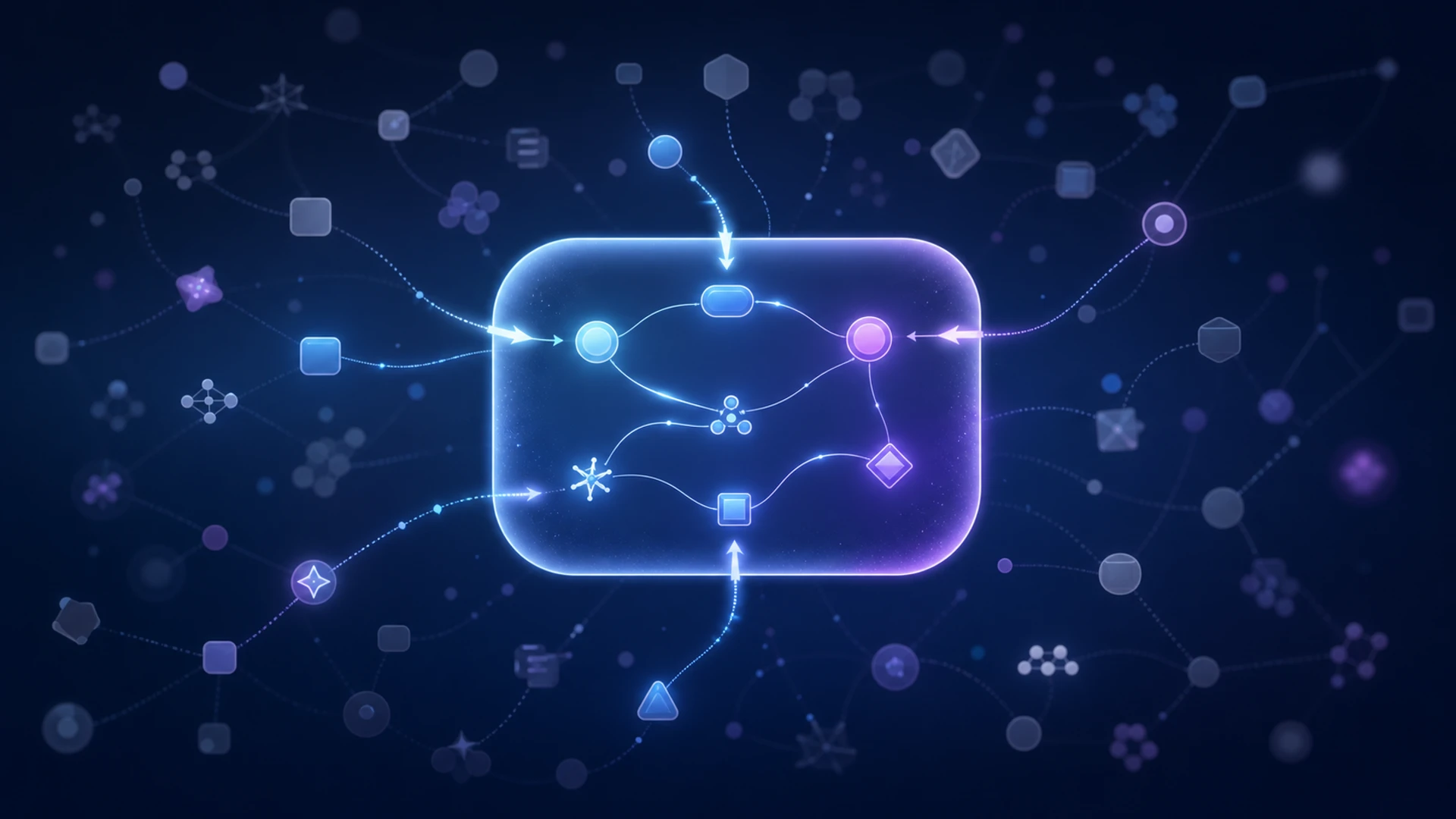 Selected AI representations entering a shared workspace
J-space is useful here as a functional metaphor: selected representations become available for report and control, while most signals stay outside the active workspace.
The research also draws on the language of Global Workspace Theory and Global Neuronal Workspace research, including work by Dehaene and Naccache on conscious access. That connection should be handled carefully. A functional workspace analogy is not the same thing as proof of subjective experience. The practical takeaway is narrower and more useful: complex reasoning benefits when relevant information is selected into a shared, controllable workspace.
The product-design lesson: selection beats exposure
The same problem appears in everyday AI work.
When a chat thread grows long, the model may still technically have the relevant facts somewhere in context. But the user and the model can both lose the current objective. When an agent can call many tools, the system has power, but it also has a larger action space. When a model can edit an entire repository, it can help more, but it can also touch the wrong surface. When completion criteria are implicit, the model may move on before the work is actually ready.
More exposure can create more coordination cost.
A good AI workflow therefore needs answers to a few questions:
- What is the current objective?
- What information belongs in the active workspace?
- Which tools are valid right now?
- Which files or resources are safe to modify?
- Where is durable state stored?
- How can the user inspect progress?
- What gate must pass before attention moves to the next step?
This is where wands come in.
What a MCPlato wand is
A MCPlato wand is a packaged AI workflow object. Instead of treating AI work as a single chat stream, a wand turns the work into a durable artifact with structure around it.
A wand can define phases, scoped tools, resource boundaries, persistent state, a runtime view, exportable outputs, and completion gates. The user and the AI are not just exchanging messages; they are building and inspecting the same object.
A helpful distinction is:
A prompt teaches the AI how to behave. A wand gives the AI and the user a shared workspace to build inside.
That makes wands different from ordinary prompt-only workflows. A prompt can say, "First research, then outline, then draft, then QA." A wand can make those steps into phases with different instructions, different visible tools, different writable resources, and different gates.
For lightweight brainstorming, that structure may be unnecessary. For multi-step work that needs state, files, validation, and a final package, the structure becomes the point.
How wands concentrate attention
If J-space suggests that useful reasoning depends on what enters a selective workspace, wands bring the same idea to the outside of the model. They reduce the number of things competing for attention.
| J-space / workspace principle | Wand mechanism | What it reduces |
|---|---|---|
| Selective workspace | Current phase | Goal ambiguity |
| Directed modulation | Phase instructions | Prompt drift |
| Reportable state | Wandfile, runtime view, and report | Hidden progress |
| Flexible reuse | Outputs and reports | One-off chat loss |
| Capacity bottleneck | Scoped tools and write boundaries | Tool and file overload |
| Attention switching | Phase gates | Premature task switching |
A wand phase says: this is the job right now. The active instructions describe what matters in that phase. The tool surface narrows the possible actions. The write boundary narrows the resource surface. The state object records where the workflow is. The runtime view makes the artifact visible. The gate decides whether attention may move forward.
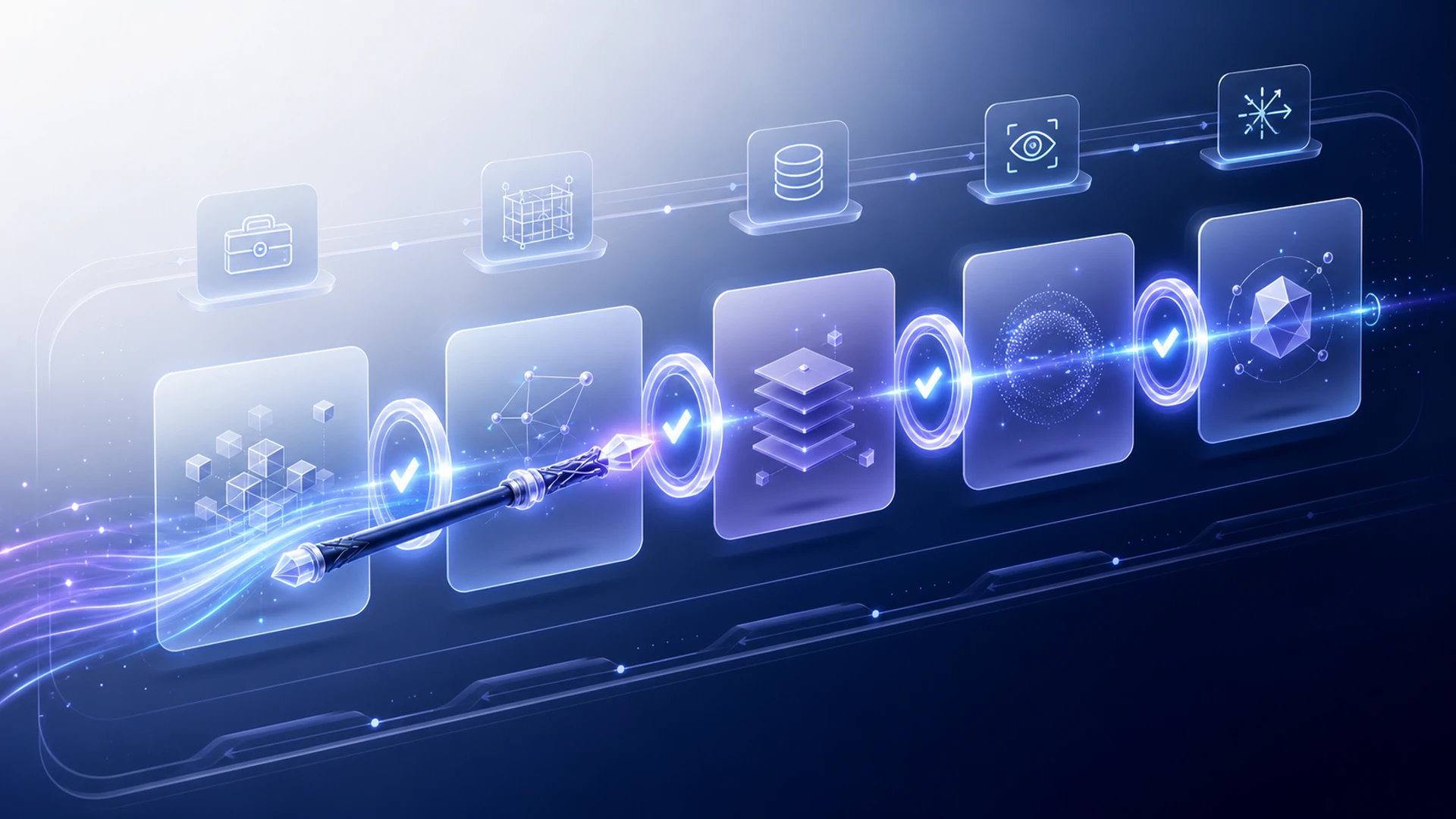 A wand workflow narrows AI work into phases with scoped tools, resources, state, and gates
A wand reduces the active workspace: the current phase defines the goal, tools, files, state, and done criteria.
This does not magically make a model smarter. It lowers the search cost of work. The same model can spend less effort rediscovering context, choosing from too many tools, guarding against accidental file edits, and reconstructing state from a transcript. More of its capacity can go into the artifact.
A practical example: an article factory as a workspace
Consider a long-form article workflow.
In a normal chat, the user might ask for research, then ask for topic options, then ask for an outline, then ask for a draft, then ask for images, translations, QA, packaging, and publishing notes. That can work, but the state is mostly conversational. The user and model must keep remembering what has already happened and what should happen next.
In a wand, the same process can become a structured workspace:
- Intake captures the brief.
- Research produces source files.
- Secondary research maps user pain points and SEO opportunities.
- Topic selection records the chosen title and slug.
- Planning defines structure, citations, visuals, and localization rules.
- Drafting writes the English source.
- Asset production creates the cover and inline images.
- Translation preserves the same slug and image paths across locales.
- QA checks sources, frontmatter, images, localization, and package structure.
- Packaging and status reporting produce a reusable deliverable.
The important part is not that every workflow must have exactly those steps. The important part is that each step has a workspace boundary. The model does not need to solve the whole project at once. It needs to satisfy the current phase and pass the gate.
That is attention design.
Where other approaches still win — and where wands fit better
Wands are not a universal replacement for every AI interface. They are one answer to a specific problem: durable, inspectable, multi-step work.
| Approach | Where it wins | Where it strains | Best fit |
|---|---|---|---|
| Prompt-only chat | Fast, flexible, low setup | State and validation live in the transcript | One-off ideation and quick answers |
| Long-context assistant | Can read more material at once | More context does not define priority, tools, files, or done criteria | Broad reading and synthesis |
| Generic agent or tool framework | Extensible and programmable | Tool access alone may still be too broad | Custom automation and integrations |
| Visual workflow builder | Predictable routing and automation | May not treat the artifact as a first-class document package | Repeatable business flows |
| MCPlato wand | Stateful artifact, scoped phases, gates, inspectable output | More structure than a quick chat | Multi-step artifact production and validated workflows |
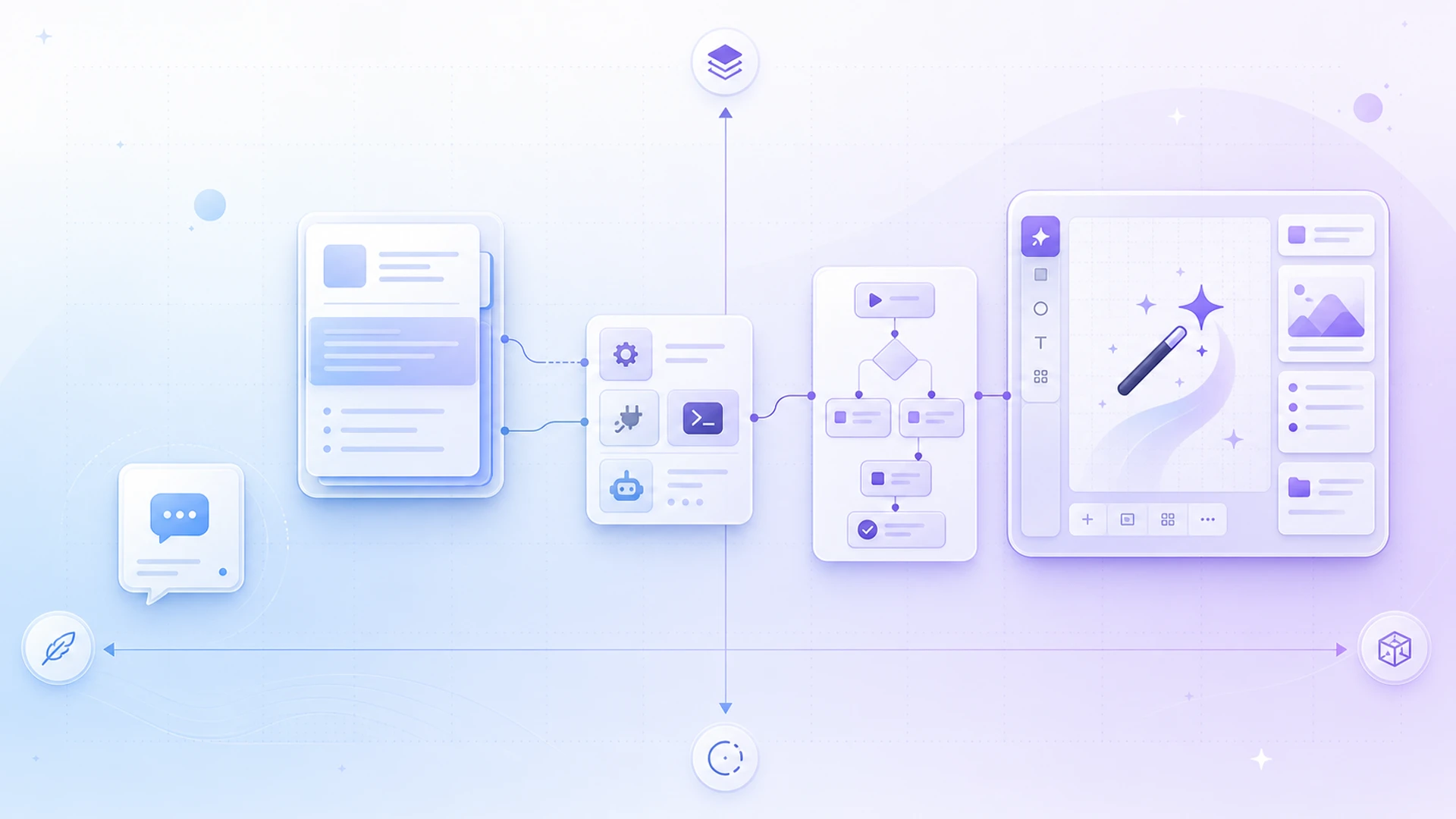 Decision map comparing quick chat, long context, tool agents, workflow automation, and durable wand workspaces
Different approaches win in different situations. Wands fit best when work needs a durable artifact, visible state, scoped tools, and validation gates.
If you only need a fast answer, chat is usually enough. If you need a custom low-level automation engine, an agent framework may be the right layer. If you need predictable business routing, a visual workflow builder can be a strong fit.
MCPlato wands are strongest when the work should become an object: a report, deck, article package, analysis, app artifact, media asset, or other deliverable that benefits from phases, validation, and inspection.
What J-space does not prove — and what wands do not claim
The J-space research is exciting, but it should not be overread.
It does not prove that language models have subjective consciousness. It does not mean interpretability can fully read a model's mind. It does not mean that every internal state is transparent. Public coverage from outlets such as VentureBeat, The Decoder, and CIO shows why the work caught attention, but the safest interpretation remains functional: some representations appear to become available for report and control in a selective workspace.
Wands should be described with the same discipline.
A wand does not give AI consciousness. It does not read the model's mind. It does not guarantee perfect reasoning. And without separate measurement, we should not claim that wands save a specific percentage of tokens, time, or attention.
The claim is simpler: wands reduce avoidable ambiguity in AI work. They define the active goal, tools, resource surface, state, artifact view, and completion gate. That makes the workspace easier for both the user and the model to manage.
Better workspaces, not just bigger windows
The next generation of AI workflows will not be defined only by larger context windows or longer-running agents. Those capabilities matter, but they do not solve the selection problem by themselves.
AI systems need workspaces that decide what belongs in focus now.
That is the lesson J-space makes newly visible inside models, and it is the lesson wands apply outside the model. Better AI work comes from reducing the active surface: fewer irrelevant tools, fewer ambiguous files, clearer state, visible artifacts, and gates that tell the system when it is safe to move on.
AI does not just need more attention. It needs a better workspace.
FAQ
What is J-space in language models?
J-space is Anthropic's term for a set of verbalizable internal representations that appear to function like a selective workspace inside a language model. The research suggests these representations can support report, instruction-driven modulation, intermediate reasoning, flexible reuse, and selectivity.
Does J-space prove AI consciousness?
No. J-space is best treated here as a functional workspace finding, not proof of subjective experience. It is useful for understanding representation, reportability, and control, but it should not be treated as evidence that a model has human-like consciousness.
What is a MCPlato wand?
A MCPlato wand is a packaged AI workflow object with phases, scoped tools, resource boundaries, persistent state, runtime views, outputs, and gates. It turns a workflow from a loose chat thread into a durable, inspectable workspace.
How do wands help AI agents stay focused?
Wands narrow the active work surface. A phase defines the current goal, the visible tools define the action space, write boundaries define where work can happen, state records progress, and gates define when the workflow can move forward.
References
- Anthropic / Transformer Circuits: "Verbalizable Representations Form a Global Workspace in Language Models"
- Stanislas Dehaene and Lionel Naccache: "Towards a cognitive neuroscience of consciousness: basic evidence and a workspace framework"
- Global Neuronal Workspace review: "Conscious Processing and the Global Neuronal Workspace Hypothesis"
- Anthropic: "Auditing Hidden Objectives"
- Anthropic: "Agentic Misalignment"
- VentureBeat: "Anthropic's new J-lens reveals a silent workspace inside Claude that mirrors a leading theory of consciousness"
- The Decoder: "Claude's hidden inner monologue is now readable thanks to Anthropic's new Jacobian Lens"
- CIO: "Anthropic shines a light into the Claude AI black hole"