The Age of Agentic IDEs: Cursor 3, Vercel Agent, and the Battle for AI-Native Workspace Dominance
Cursor 3, Vercel Agent, and Google Antigravity are redefining development. We analyze the shift from IDEs to Agent-Native Workspaces—and where MCPlato fits.
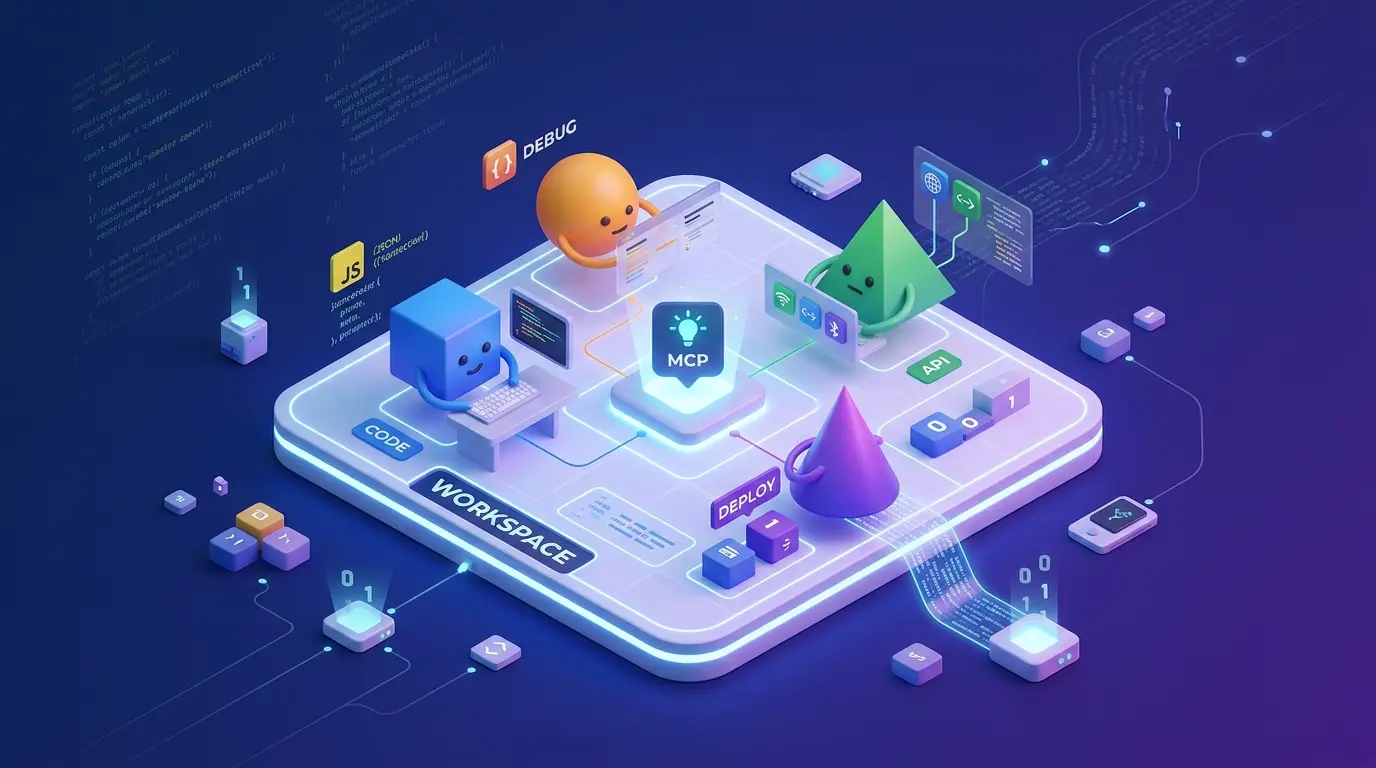 Cover
Cover
The Age of Agentic IDEs: Cursor 3, Vercel Agent, and the Battle for AI-Native Workspace Dominance
Introduction
On April 13, 2026, Cursor dropped Cursor 3—and with it, the Agents Window. For the first time, the beloved AI-native code editor moved beyond a conversational sidebar and into true multi-agent orchestration. Developers could now spin up parallel agents to hunt bugs, refactor modules, and write tests simultaneously, all within the same project context. Less than a week later, Vercel expanded its Agent capabilities, tightening the loop between code generation and edge deployment until the two felt indistinguishable. Something fundamental is shifting: the standalone IDE is dying, and the Agent-Native Workspace is being born.
For decades, the integrated development environment was a text editor with plugins. Then came the AI copilot era, where a single model whispered suggestions line-by-line. Now we are entering the third wave: environments where agents are first-class citizens, capable of autonomous reasoning, cross-file navigation, and real-world execution. The question is no longer which model you use, but which workspace can best choreograph those models into coherent, reliable, and scalable workflows.
The Agentic IDE Explosion
The evidence that Agentic IDEs have crossed the chasm is overwhelming. According to recent industry data, 84% of developers now use AI coding tools as part of their daily workflow, and a staggering 61% of Java code in production repositories is now AI-generated [1]. These are not junior developers asking ChatGPT for loops; they are senior engineers delegating entire feature branches to autonomous agents.
Cursor 3 and the Agents Window
Cursor has long led the charge in AI-native editing. With Cursor 3, the company introduced the Agents Window, a dedicated pane where multiple agents can run in parallel against the same codebase [2]. Each agent maintains its own reasoning trace, file locks, and execution history, while a central orchestrator resolves conflicts and merges changes. The result is a dramatic acceleration in complex refactoring tasks that previously required hours of human coordination.
Vercel Agent: From Code to Edge
Vercel’s strategy has always been about collapsing the distance between creation and deployment. The Vercel Agent takes this to its logical extreme: you describe a feature, the agent generates the component, runs the build, provisions infrastructure, and deploys to the edge [3]. What makes it powerful is not code generation alone, but the depth of integration with the Vercel platform. Preview URLs, analytics, and security policies are all within the agent’s operational radius. For frontend teams, the deployment pipeline has effectively become invisible.
Google AI Studio Antigravity
Not to be outdone, Google unveiled Antigravity inside AI Studio, positioning it as a full-stack "vibe coding" environment [4]. Antigravity leverages Google’s latest Gemini models to generate not just frontend components but backend services, database schemas, and even CI/CD configurations. It is tightly woven into the Google Cloud ecosystem, offering seamless access to Firebase, BigQuery, and Vertex AI. For enterprises already entrenched in Google’s stack, Antigravity presents a compelling end-to-end proposition.
Product Comparison
While all three products claim to be "agentic," their philosophies diverge sharply across five critical dimensions.
| Dimension | Cursor 3 | Vercel Agent | Google Antigravity |
|---|---|---|---|
| Agent Parallelism | High. Dedicated Agents Window supports multiple concurrent agents with conflict resolution [2]. | Medium. Strong sequential task chaining; limited explicit parallel agent execution [3]. | Medium-High. Gemini-powered multi-turn agents can fork tasks, but parallelism is model-orchestrated rather than workspace-native [4]. |
| Deployment Integration Depth | Shallow by default. Relies on external CI/CD or manual deployment; third-party plugins available. | Deep. Native integration with Vercel deployments, preview environments, edge config, and analytics [3]. | Deep. Native tie-ins to Google Cloud Run, Firebase, and Cloud Build [4]. |
| Target User Group | Software engineers and technical leads who want fine-grained control over code quality and architecture. | Frontend developers, product engineers, and design-driven teams prioritizing speed-to-preview. | Enterprise developers, full-stack teams, and organizations already invested in Google Cloud. |
| Context Management Strategy | Codebase-centric. Embeds entire repositories into vector indexes and maintains file-level context windows [2]. | Project-centric. Context is scoped to a Vercel project, including environment variables, team settings, and deployment history [3]. | Cloud-centric. Context spans across GCP services, IAM roles, and organizational resource boundaries [4]. |
| Ecosystem Openness | Moderate. Supports MCP and custom extensions, but primarily optimized for local or Git-backed repositories. | Low-Moderate. Deeply integrated with Vercel’s proprietary platform; limited portability outside the ecosystem [3]. | Low. Strong lock-in to Google Cloud services and Gemini models [4]. |
This table reveals a clear pattern: each player is optimizing for a different gravitational center. Cursor orbits around the codebase, Vercel around the deployment target, and Google around the cloud suite. None of them is trying to be a generic workspace. And that gap is precisely where the next battle will be fought.
The Workspace Layer
If the first phase of AI tooling was about model quality, and the second phase was about IDE integration, the third phase is about workspace orchestration. As frontier models continue to commoditize—GPT-4o, Claude 3.7 Sonnet, and Gemini 2.5 Pro are now broadly interchangeable for many coding tasks—the moat moves up the stack. The differentiator is no longer how smart your agent is, but how well your workspace can coordinate many agents, manage shared context, and integrate with diverse tools and workflows.
Consider what a modern engineering workflow actually looks like. A single feature request might require:
- A research agent to analyze competitor implementations and API documentation.
- A design agent to generate UI mockups and accessibility guidelines.
- An engineering agent to scaffold components, write tests, and handle edge cases.
- A DevOps agent to provision infrastructure, configure secrets, and monitor rollout.
- A QA agent to run synthetic tests and flag regressions.
In a traditional IDE, these tasks are siloed across Slack, Figma, GitHub, Jira, and AWS. In an Agent-Native Workspace, they should be first-class, collaborative entities operating within a unified context layer. The workspace becomes the operating system for work itself—not just code, but the full lifecycle of ideas becoming reality.
The key architectural challenges at this layer are:
- Context threading: How do you maintain a coherent narrative across agents with different specializations and memory horizons?
- Permission boundaries: How do you ensure the DevOps agent cannot accidentally delete production databases while the research agent roams the public internet?
- Observability and auditability: When an autonomous agent makes a decision, who is responsible? Can you replay its reasoning trace?
- Human-in-the-loop design: Where does the human step in to approve, correct, or redirect? The workspace must make this frictionless.
These are not coding problems. They are coordination problems. And they demand a new category of product: the general-purpose AI Native Workspace.
MCPlato Integration
This brings us to the fourth path—one that does not anchor itself to a specific IDE, cloud, or deployment target. MCPlato is a general-purpose AI Native Workspace built from the ground up around multi-agent orchestration, session isolation, and deep tool integration [5]. Rather than competing with Cursor on code editing or with Vercel on edge deployment, MCPlato operates at the workspace layer itself, treating agents as composable workers across research, writing, translation, engineering, and operations.
Here is what that means in practice.
Cross-Task Multi-Agent Orchestration
In MCPlato, specialized agents such as Researcher, Writer, Engineer, and Translator coexist within the same workspace. A user can kick off a research task on emerging vector database architectures, hand the findings to an Engineer agent to prototype a storage layer, and then pass the resulting documentation to a Writer agent for a technical blog post—all without leaving the workspace. Each agent understands its role, boundaries, and handoff protocols. This is not a chatbot with a system prompt swap; it is a structured orchestration layer designed for complex, cross-domain workflows.
Session-Based Isolation
Every project in MCPlato lives inside a session with strict isolation boundaries. Context, files, tool credentials, and agent memories are scoped to the session, preventing the common "cross-contamination" problem where an agent working on Project A accidentally references a file or API key from Project B. This makes MCPlato particularly suitable for agencies, consultancies, and enterprise teams juggling multiple clients or product lines simultaneously.
Native MCP Integration
MCPlato embraces the Model Context Protocol (MCP) natively, allowing users to plug in external data sources, APIs, and execution environments without vendor lock-in [5]. Whether you want to connect a private knowledge base, a custom CI/CD pipeline, or an internal microservice, the workspace treats these as standard agent tools. This stands in contrast to the walled-garden approaches of cloud-tied competitors.
ClawMode: Long-Horizon Autonomous Operation
One of the defining capabilities of MCPlato is ClawMode, a long-running autonomous execution mode where agents can operate across extended time horizons. Rather than requiring the user to babysit every prompt, ClawMode agents can schedule follow-up tasks, wait for external events, and resume execution asynchronously [5]. This is essential for real-world workflows that do not fit into a single chat session—such as overnight data pipelines, multi-day research sprints, or iterative design explorations.
Audit Logs and Permission Control
As organizations delegate more authority to AI agents, governance becomes non-negotiable. MCPlato provides built-in audit logging that records every agent decision, tool invocation, and file modification. Combined with granular permission controls, administrators can define exactly which agents can access which tools, data sources, and execution environments. This transforms the workspace from a productivity tool into an enterprise-grade operating platform.
In short, while Cursor 3, Vercel Agent, and Google Antigravity are converging on the developer workflow from different directions, MCPlato is building the workspace layer underneath all of them—a place where agents from any domain can collaborate, where context is managed as a first-class resource, and where humans remain in command.
Conclusion & Outlook
The Agentic IDE explosion is not a fad. It is the third wave of software tooling, following the command line and the graphical IDE. Cursor 3, Vercel Agent, and Google Antigravity are each advancing the state of the art, but they are also revealing the limits of product categories built around a single vertical: code editing, frontend deployment, or cloud infrastructure.
The real prize is the Workspace layer: the orchestration plane that turns individual agents into cohesive teams, that weaves context across tools and time, and that gives enterprises the confidence to delegate real work to autonomous systems. The winner of this battle will not be the company with the best model, but the one with the best context architecture.
For developers, technical PMs, and AI engineers, the implication is clear. Start evaluating tools not just by their autocomplete quality or deployment speed, but by how well they manage multi-agent context, cross-tool integration, and human oversight. The age of the standalone IDE is ending. The age of the Agent-Native Workspace has just begun.
References
- Stackademic Industry Report, April 2026. "84% of Developers Use AI Coding Tools in April 2026." https://blog.stackademic.com/84-of-developers-use-ai-coding-tools-in-april-2026-only-29-trust-what-they-ship-d0cb7ec9320a
- Cursor Blog. "Cursor 3: The Agents Window." https://cursor.com/blog/cursor-3
- Vercel Documentation. "Vercel Agent." https://vercel.com/docs/agent
- Google Blog. "Full-Stack Vibe Coding with Google AI Studio: Antigravity." https://blog.google/innovation-and-ai/technology/developers-tools/full-stack-vibe-coding-google-ai-studio/
- MCPlato. "AI Native Workspace for Multi-Agent Orchestration." https://mcplato.com